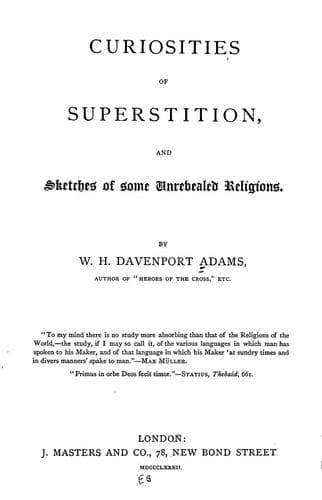
Curiosities of Superstition, and Sketches of Some Unrevealed ReligionsAdams, W. H. Davenport (William Henry Davenport)
Religion
Curiosities of Superstition, and Sketches of Some Unrevealed Religions
Adams, W. H. Davenport (William Henry Davenport)
Folklore; Religions; Superstition
“There are ten commandments which Buddha imposes on his disciples. They
are--not to kill, not to steal, not to commit adultery, not to lie, not to
get intoxicated, to abstain from unseasonable meals, to abstain from
public spectacles, to abstain from expensive dresses, not to have a large
bed, not to receive silver or gold. The duties of those who embraced a
religious life were most severe. They were not allowed to wear any dress
except rags collected in cemeteries, and these rags they had to sew
together with their own hands; a yellow cloak was to be thrown over these
rags. Their food was to be extremely simple, and they were not to possess
anything except what they could get by collecting alms from door to door
in their wooden bowl. They had but one meal in the morning, and were not
allowed to touch any food after midday. They were to live in forests, not
in cities, and their only shelter was to be the shadow of a tree. There
they were to sit, to spread their carpet, but not to lie down, even during
sleep. They were allowed to enter the nearest city or village in order to
beg, but they had to return to their forest before night, and the only
change which was allowed, or rather prescribed, was, when they had to
spend some nights in the cemeteries, there to meditate on the vanity of
all things. And what was the object of all this asceticism? Simply to
guide each individual towards that path which would finally bring him to
Nirvâna, to utter extinction or annihilation. The very definition of
virtue was that it helped man to cross over to the other shore, and that
other shore was not death, but the cessation of all being. Thus charity
was considered a virtue; modesty, patience, courage, contemplation, and
science, all were virtues, but they were practised only as a means of
arriving at deliverance.”
Buddha himself was an incarnation of the virtues. His charity, for
example, was melting as day. When he saw a tigress standing, and unable to
feed her cubs, he offered up his body to be devoured by them. The Chinese
pilgrim, visiting the spot on the banks of the Indus where this miracle
was supposed to have occurred, remarks that the soil was still red with
the blood of Buddha, as were also the trees and flowers.
Public-domain text, read in full here on John Shaqi.
Reviews
Reviews
No reviews yet
Be the first to share your thoughts on this work.
Join the Discussion
Join the discussion
Sign in to leave a comment or review.
Sign InorCreate an account