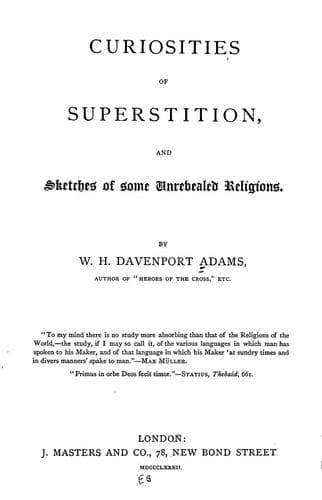
Curiosities of Superstition, and Sketches of Some Unrevealed ReligionsAdams, W. H. Davenport (William Henry Davenport)
Religion
Curiosities of Superstition, and Sketches of Some Unrevealed Religions
Adams, W. H. Davenport (William Henry Davenport)
Folklore; Religions; Superstition
The Fijians conceive that the way to Buruto, or Heaven, is impeded by many
difficulties, except for the great chiefs, and that, therefore, the only
certain plan for a man of inferior rank is to impose upon the god with a
lie,--declaring himself to be a chief with so much earnestness that the
god believes him, and allows him to pass! Probably in no other creed is
admission to heaven made to depend upon a lie! With his war club and a
whale’s tooth on his shoulder, the spirit journeys to the world’s end.
There grows the sacred pine, at which the spirit hurls his whale’s tooth.
If he miss the mark, his journey comes to an abrupt termination; if he hit
it, he travels onward until he reaches the spot where the spirits of the
women murdered at his death await his arrival.
With these faithful attendants he goes forward, but is opposed by a god
called Ravuyalo, against whom he employs his club. If he be defeated, the
god kills and eats him; if he conquer, he again goes forward until he
falls in with a canoe. Embarking, he is conveyed to the celestial heights
where dwells the supreme god, Ndengei. Over the brink of the cliff
stretches the long-steering oar of the god’s canoe. He is asked his name
and rank, and to this inquiry he replies with a detailed and very
imaginative recital of his greatness and opulence, the heroic deeds he has
achieved, the devastation he has effected, and the realms over which he
has ruled. He is then commanded to seat himself on the blade of the oar,
and, if his story have met with credence, he is borne aloft into Buruto;
if Ndengei disbelieves it, the oar is tilted up, and he is hurled down for
ever into the watery depths of blackness.
Bachelors are not admitted into Buruto, because as we have stated, the
spirit waits for his wives, to prove that he is married. And if an
unmarried man venture on the journey, a goddess called the Great Woman,
throws herself in his way. She bears towards bachelors an implacable
hatred, and no sooner sees one than she springs upon him and tears him to
pieces. In her haste she sometimes misses him; but even then he has to
contend against another god, who conceals himself by the side of the path,
and as the bachelor spirit passes by, leaps upon him, and dashes him
against a stone.
There is a ghastliness about the funeral ceremonies of the Fijians which
far surpasses even the dreary desolation of those in vogue among
ourselves.
Public-domain text, read in full here on John Shaqi.
Reviews
Reviews
No reviews yet
Be the first to share your thoughts on this work.
Elsewhere in the archive
Join the Discussion
Join the discussion
Sign in to leave a comment or review.
Sign InorCreate an account