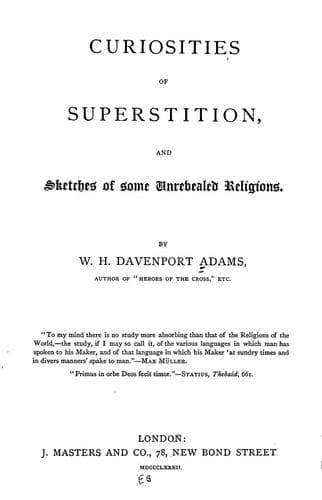
Curiosities of Superstition, and Sketches of Some Unrevealed ReligionsAdams, W. H. Davenport (William Henry Davenport)
Religion
Curiosities of Superstition, and Sketches of Some Unrevealed Religions
Adams, W. H. Davenport (William Henry Davenport)
Folklore; Religions; Superstition
In common with several other savage tribes they hold that men and women
who have grown decrepit and infirm have lived their lives, and should
withdraw from this world of activity. Accordingly though they may be
neither dead nor dying, preparations are made for their interment. And it
seems that the moribund themselves do not object to this summary
anticipation of the moment of dissolution; on the contrary, when they
become sensible of infirmity, they invite their sons to strangle them.
While the sons, far from objecting to an act of parricide, will intimate
to their aged parents, if they delay the request, that they have lived
long enough, and that it will be well for them to enjoy the rest of the
grave. On both sides this singular conduct is due apparently to the Fijian
belief that the condition of the spirit in the next world will exactly
resemble that of the individual in this; and consequently everybody is
desirous to cross the threshold while he retains some degree of activity
of body.
Alone we must die, but we need not pass alone into the spirit-world! Such
is the conviction of the Fijians, and accordingly they provide a dead
chief with attendants, by strangling at his grave his favourite wives. And
they slay a valiant warrior that he may precede him on his journey, and do
battle for him with all evil spirits or demons. These victims are called
“grass,” and lie at the bottom of the chieftain’s grave; the wives decked
out in fleecy folds of the softest masi, the servants with their various
implements in their hands, and the warrior equipped for the strife, with
his favourite club by his side. No resistance is offered by any one of the
sufferers; no attempt is made to escape; all seem to contend for the
honour of escorting their chief into the other world.
Mr. Williams was present at the funeral of the King of Somo-somo in
August, 1845. Age was beginning to tell upon him, but there was no
immediately dangerous symptom, and on the 21st, when Mr. Williams visited
him, he was better than he had been for two or three days before. Judge,
then, of the missionary’s surprise, when, on the 24th, he was informed
that the king was dead, and that preparations were being made for his
interment, he could scarcely believe the report. The ominous word
“preparations” induced him to hasten at once to the scene of action, but
his utmost speed failed to bring him to Nasima, the king’s house, in time.
The moment he entered it was evident that, as far as concerned two of the
women, he was too late to save their lives. The effect of that ghastly
scene was overwhelming. Scores of deliberate murderers in the very act
surrounded him; yet was there no confusion, and the unearthly horrid
stillness was broken only by an occasional word from him who presided.
Nature seemed to lend her aid to enhance the impression of horror; there
was not a breath in the air, and the half subdued light in that hall of
death revealed every object with unusual distinctness.
Public-domain text, read in full here on John Shaqi.
Reviews
Reviews
No reviews yet
Be the first to share your thoughts on this work.
Elsewhere in the archive
Join the Discussion
Join the discussion
Sign in to leave a comment or review.
Sign InorCreate an account