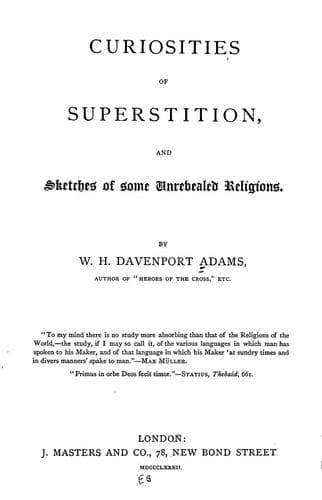
Curiosities of Superstition, and Sketches of Some Unrevealed ReligionsAdams, W. H. Davenport (William Henry Davenport)
Religion
Curiosities of Superstition, and Sketches of Some Unrevealed Religions
Adams, W. H. Davenport (William Henry Davenport)
Folklore; Religions; Superstition
“All was motionless as sculpture, and”--writes Mr. Williams--“a strange
feeling came upon me, as though I was myself becoming a statue. To speak
was impossible; I was unconscious that I breathed; and involuntarily, or
rather against my will, I sank to the floor, assuming the cowering posture
of those who were actually engaged in murder. My arrival was during a
hush, just at the crisis of death, and to that strange silence must be
attributed my emotions; and I was but too familiar with murders of this
kind, neither was there anything novel in the apparatus employed.
Occupying the centre of that large room were two groups, the business of
whom could not be mistaken.
“All sat on the floor; the middle figure of each group being held in a
sitting posture by several females, and hidden by a large veil. On either
side of each veiled figure was a company of eight or ten strong men, one
company hauling against the other a white cord which was passed twice
round the neck of the doomed one, who thus in a few minutes ceased to
live. As my self-command was returning to me the group furthest from me
began to move; the men slackened their hold, and the attendant women
removed the large covering, making it into a couch for the victim.”
Mr. Williams now repaired to the hut of the deceased king, to intercede
with his successor on behalf of the other intended victims. Judge of his
surprise and horror to find the king still alive. He was very feeble, it
was true, but he retained complete consciousness, and occasionally put his
hand to his side as his cough shook and tortured him. The young king
seemed overcome with grief, and embracing Mr. Williams, said: “See, the
father of us two is dead.” He regarded his father’s movements, even his
speaking and taking food, as mechanical; in his view, the spirit had
departed, and nothing remained but an infirm, and, therefore, valueless
body. The preparations for the funeral were not interrupted, and Mr.
Williams could obtain no hearing for his expostulations. The young chief’s
principal wife and an attendant busily dusted his body with black powder,
as if dressing him for the war-dance; and bound his arms and legs with
long rolls of white masi, tied in rosettes, with the ends streaming on the
ground. He was attired in a new masi robe, which fell about him in ample
folds; his head was decorated with a scarlet handkerchief, arranged
turban-wise, and ornamented with white cowrie-shells, strings of which
flashed on his dusky arms; while round his neck depended an ivory
necklace, composed of long curved claw-like pieces of whale’s teeth.
Public-domain text, read in full here on John Shaqi.
Reviews
Reviews
No reviews yet
Be the first to share your thoughts on this work.
Elsewhere in the archive
Join the Discussion
Join the discussion
Sign in to leave a comment or review.
Sign InorCreate an account