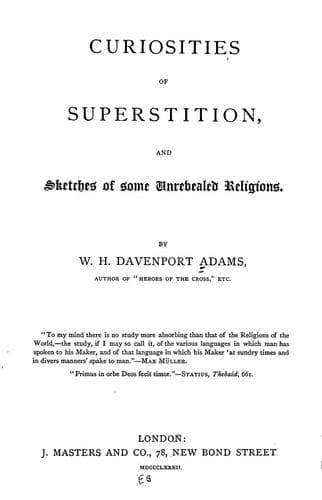
Curiosities of Superstition, and Sketches of Some Unrevealed ReligionsAdams, W. H. Davenport (William Henry Davenport)
Religion
Curiosities of Superstition, and Sketches of Some Unrevealed Religions
Adams, W. H. Davenport (William Henry Davenport)
Folklore; Religions; Superstition
According to the Maories, the soul is not confined absolutely within the
limits of the Reinga, but may at its will revisit “the glimpses of the
moon,” and converse with its former friends and kinsmen,--of course, only
through the medium of the tohungas. The latter are sometimes favoured with
a view of the spiritual visitor, who takes the form of a sunbeam or a
shadow, and speaks with a low whistling voice, like the sound of a light
air passing through trees. This voice is occasionally heard by the
uninitiated, but the language it speaks can be comprehended by none but
the tohungas.
* * * * *
Respecting the wairuas, it is difficult to gather any satisfactory
information. The word “wairua” means either “a dream,” or “the soul,” and
Dr. Dieffenbach says it is chiefly used to signify the spirit of some
dead man or woman who is supposed to cherish a malignant feeling towards
the living. The wairuas frequent certain localities, such as
mountain-tops, which the Maori consequently takes good care not to visit.
* * * * *
It is a necessary result of the Maori belief in atuas and wairuas that
these should foster a belief in witchcraft. Individuals of bolder and
stronger minds than the majority will always claim a special relationship
to the unseen Powers, and avail themselves of this pretended relationship
to work upon the popular imagination. Convince the ignorant of the
existence of evil deities, and he will listen readily to any who tell him
that they can shield him from their malignant influence. And then it
naturally follows, “as the night the day,” that all misfortunes arising
from unseen or unintelligible causes, will be attributed to witchcraft. A
vast--an almost boundless field is thus opened up to the practice of human
unscrupulousness and the weakness of human incredulity.
Let a Maori chief lose some valued article, or suffer from an attack of
illness, and he immediately concludes that he has been bewitched. Who has
bewitched him? He fixes, as a matter of course, on the individual whom he
conceives to be his enemy, and orders him to be put to death. Or he
resorts to some potent witch, and bribes her to exercise her influence to
remove the maleficent spell under which he is labouring.
Public-domain text, read in full here on John Shaqi.
Reviews
Reviews
No reviews yet
Be the first to share your thoughts on this work.
Elsewhere in the archive
Join the Discussion
Join the discussion
Sign in to leave a comment or review.
Sign InorCreate an account