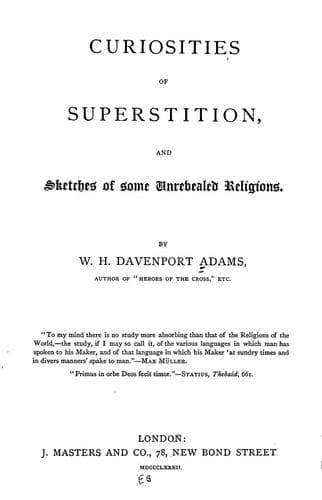
Curiosities of Superstition, and Sketches of Some Unrevealed ReligionsAdams, W. H. Davenport (William Henry Davenport)
Religion
Curiosities of Superstition, and Sketches of Some Unrevealed Religions
Adams, W. H. Davenport (William Henry Davenport)
Folklore; Religions; Superstition
According to Dr. Dieffenbach, the particular haunt of the witches is--or
rather _was_, for Christianity has rapidly extended its blessed power over
the population of New Zealand--a place called Urewera, in the North
Island, between Hawkes Bay and Taupo. The natives of this wild and
deserted district are reported to be the greatest witches in the country;
are much feared and studiously avoided by the neighbouring tribes. When
they come down to the coast, the natives there are almost afraid to oppose
their most extravagant demands, lest they should incur their displeasure.
It is said that they use the saliva of the people they design to bewitch,
and, therefore, visitors carefully conceal it, so as to deprive them of
the opportunity of working mischief. Yet, like the witches and sorcerers
of mediæval England, they appear to be more sinned against than sinning,
and by no means to deserve the ill reputation which attaches to them.
It is a curious fact, says Dr. Dieffenbach, which has been noticed in
Tahiti, Hawaii, and the Polynesian islands generally, that the first
intercourse of their inhabitants with Europeans produces civil war and
social degradation, but that a change of ideas is rapidly effected, and
the most ancient and apparently inveterate prejudices soon become a
subject of ridicule, and are swept away. The grey priest, or tohunga,
skilled in all the mysteries of witchcraft and native medical treatment,
readily yields in his attendance on the sick to every European who
possesses, or affects to possess, a knowledge of the science of surgery or
medicine, and laughs at the former credulity of his patient. It is evident
that, while deceiving others, he never deceived himself, and was well
aware of the futility of his pretended remedies.
When a New Zealand chief or his wife fell sick, the most influential
tohunga, or some woman enjoying a special odour of sanctity, was instantly
called in, and waited night and day upon the patient, sometimes repeating
incantations over him, and sometimes sitting in front of the house, and
praying. The following is the incantation which the priests profess to be
a cure for headache. The officiant pulls out two stalks of the _Pteris
esculenta_, from which the fibres of the root must be removed, and beating
them together over the patient’s head, says this chant. It is entitled, “A
prayer for the sick man, when his head aches: to Atua this prayer is
offered, that the sick man may become well.”
Public-domain text, read in full here on John Shaqi.
Reviews
Reviews
No reviews yet
Be the first to share your thoughts on this work.
Elsewhere in the archive
Join the Discussion
Join the discussion
Sign in to leave a comment or review.
Sign InorCreate an account