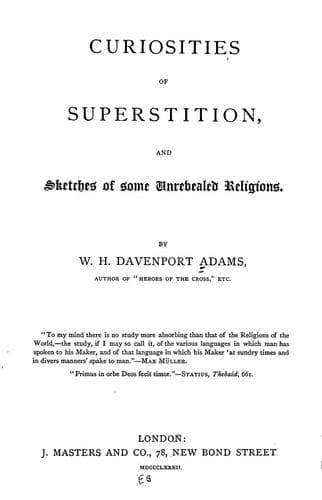
Curiosities of Superstition, and Sketches of Some Unrevealed ReligionsAdams, W. H. Davenport (William Henry Davenport)
Religion
Curiosities of Superstition, and Sketches of Some Unrevealed Religions
Adams, W. H. Davenport (William Henry Davenport)
Folklore; Religions; Superstition
On the occasion of a chiefs illness, all his kith and kin gather around
his house, and give way to the loudest lamentations, in which the invalid
is careful to join. When the weeping and wailing capacities of one village
have been exhausted he is carried to another, and the process is repeated.
But in New Zealand, as elsewhere, the common lot cannot be averted by
sorrowing humanity; the sick man dies; and then all that remains to the
survivors is to show their respect and regret by such funeral pomp as they
are able to devise. They assemble round the dead body, after it has been
equipped in its bravest attire, and indulge in the most violent
demonstrations of grief,--partly feigned, no doubt, but partly sincere.
This luxury of woe, however, is chiefly accorded to the women, who display
that extravagance of passion we are accustomed to regard as characteristic
of the Southern nations. They throw themselves upon the ground, wrap their
faces and bodies in their mantles, shriek and sob aloud, wave their arms
frantically in the air, and finally gash and scar their skin with long,
deep cuts, which they fill in with charcoal until they become indelible
records of the loss they have sustained. Funeral orations, full of the
most vehement eulogies, and interrupted by complaints and reproaches
against the dead man for his unkindness in going away from them, are
incessantly delivered. These ceremonies completed, they place the corpse
in a kind of coffin, along with various emblems of the rank of the
departed, and leave it to decay.
The process of decomposition is completed in about seven or eight months;
the ceremony of the _hahunga_ then takes place. The friends and relatives
assemble; the bones are removed from the coffin, and cleaned; a supply of
provisions is passed around; a new series of funeral panegyric is spoken;
and the _tiki_, _merai_, and other symbols of the departed chieftain’s
headship are handed over to his eldest son, who is thus invested with his
father’s power and privileges.
Public-domain text, read in full here on John Shaqi.
Reviews
Reviews
No reviews yet
Be the first to share your thoughts on this work.
Elsewhere in the archive
Join the Discussion
Join the discussion
Sign in to leave a comment or review.
Sign InorCreate an account