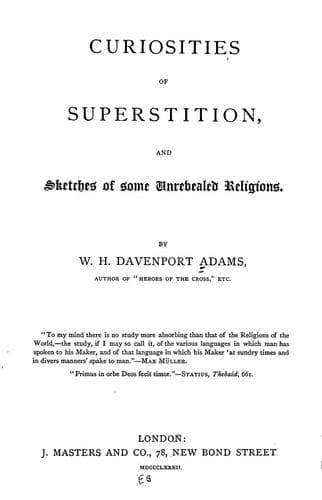
Curiosities of Superstition, and Sketches of Some Unrevealed ReligionsAdams, W. H. Davenport (William Henry Davenport)
Religion
Curiosities of Superstition, and Sketches of Some Unrevealed Religions
Adams, W. H. Davenport (William Henry Davenport)
Folklore; Religions; Superstition
The place where the dead body lies while undergoing decomposition, the
waki-tapu, as it is called, is frequently distinguished by peculiar signs,
and the neighbourhood left uninhabited. Mr. Angas describes a visit which
he paid to the village of Huriwonua. Its chief had died about six weeks
before the visit, and Mr. Angas, on arriving there, found it entirely
deserted. “From the moment the chief was laid beneath the upright canoe,
on which were inscribed his name and rank, the whole village, he says,
became strictly tapu, or sacred, and not a native, on pain of death, was
permitted to trespass near the spot. The houses were all fastened up, and
on most of the doors were inscriptions denoting that the property of such
an one remained there. An utter silence pervaded the place. After
ascertaining,” says Mr. Angas, “that no natives were in the vicinity of
the forbidden spot, I landed, and trod the sacred ground; and my footsteps
were probably the first, since the desertion of the village, that had
echoed along its palisaded passages.
“On arriving at the tomb, I was struck with the contrast between the
monument of the savage and that of the civilised European. In the erection
of the latter, marble and stone and the most durable of metals are
employed, while rapidly-decaying wood, red ochre, and feathers form the
decorations of the Maori tomb. Huriwonua having been buried only six
weeks, the ornaments of the _waki-tapu_, or sacred place, as those
erections are called, were fresh and uninjured. The central upright canoe
was thickly painted with black and red, and at the top was written the
name of the chief; above which there hung in clusters bunches of _kaka_
feathers, forming a large mass at the summit of the canoe. A double fence
of high palings, also painted red, and ornamented with devices in
arabesque work, extended round the grave, and at every fastening of flax,
when the horizontal rails were attached to the upright fencing, were stuck
two feathers of the albatross, the snowy whiteness of which contrasted
beautifully with the sombre black and red of the remainder of the
monument.”
Public-domain text, read in full here on John Shaqi.
Reviews
Reviews
No reviews yet
Be the first to share your thoughts on this work.
Elsewhere in the archive
Join the Discussion
Join the discussion
Sign in to leave a comment or review.
Sign InorCreate an account