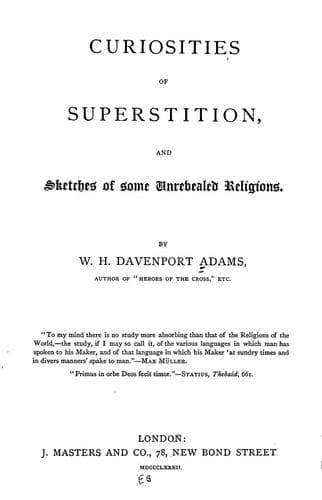
Curiosities of Superstition, and Sketches of Some Unrevealed ReligionsAdams, W. H. Davenport (William Henry Davenport)
Religion
Curiosities of Superstition, and Sketches of Some Unrevealed Religions
Adams, W. H. Davenport (William Henry Davenport)
Folklore; Religions; Superstition
We have entered at some length into an explanation of the system of Tapu,
or Taboo, in our remarks on the religion of the Polynesians. It prevails,
as we have already stated, in New Zealand; and though its disadvantages
are many, and it is capable of great abuse, it serves nevertheless as a
substitute for law, and to a large extent protects both life and property.
For, supported and enforced as it is by the superstitious feelings of the
people, it erects an insuperable barrier between possession and
acquisition; it plays the part of a social police; it maintains the moral
standard; it shields the feeble from the oppression of the strong. A man
quits his dwelling for his day’s work: he places the tapu mark on his
door, and thenceforward his dwelling is inviolate. Or he selects a tree
which will fashion into a good canoe; he distinguishes it with the tapu
mark, and it becomes his own. Civilisation has designed no more effectual
protection.
But like all restrictive and prohibitive systems, it is easily pushed to
an inconvenient excess, and made an instrument of extortion or oppression
in the hands of the chief or priest. It is much in favour, says Mr.
Williams, among the chiefs, who adjust it so that it sits easily on
themselves, while they use it to gain influence over those who are nearly
their equals; by means of it they supply their most important wants, and
command at will all who are beneath them. If any object touch a chief’s
garment it becomes tapu; so, too, if a drop of his blood fall upon it;
and, more particularly, it consecrates his head. To mention or refer to a
chief’s head is an insult. Mr. Angas says that a friend of his, in
conversing with a Maori chief about his crops, inadvertently said: “Oh, I
have some apples in my garden as large as that little boy’s head!”
pointing at the same time to the chief’s son. This reference was felt and
resented as a deadly insult, and it was only with the greatest difficulty
that the incautious speaker obtained forgiveness. So very much _tapu_ is a
chiefs head that, should he touch it with his own fingers, he must touch
nothing else until he has applied the hand to his nostrils and smelt it,
and thus restored to the head the virtue that departed from it when first
touched. The hair is likewise sacred; it is cut by one of his wives, who
receives every particle in a cloth, and buries it in the ground. The
operation renders _her_ tapu, for a week, during which time she is not
allowed to make use of her hands.
Public-domain text, read in full here on John Shaqi.
Reviews
Reviews
No reviews yet
Be the first to share your thoughts on this work.
Elsewhere in the archive
Join the Discussion
Join the discussion
Sign in to leave a comment or review.
Sign InorCreate an account