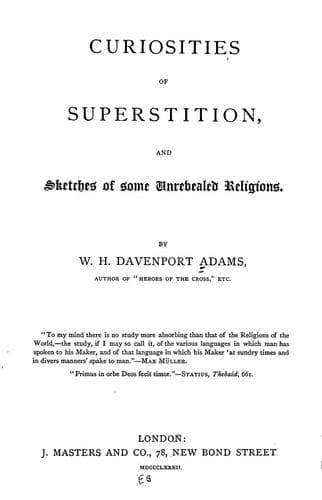
Curiosities of Superstition, and Sketches of Some Unrevealed ReligionsAdams, W. H. Davenport (William Henry Davenport)
Religion
Curiosities of Superstition, and Sketches of Some Unrevealed Religions
Adams, W. H. Davenport (William Henry Davenport)
Folklore; Religions; Superstition
The carved image of a chief’s head is not less sacred than the head
itself. Dr. Dieffenbach says: “In one of the houses of Te Puai, the head
chief of all the Waikato, I saw a bust, made by himself, with all the
serpentine lines of the aroko, or tattooing. I asked him to give it to me,
but it was only after much pressing that he parted with it. I had to go to
his house to fetch it myself, as none of his tribe could legally touch it,
and he licked it all over before he gave it to me; whether to take the
tapu off, or whether to make it more strictly sacred, I do not know. He
particularly engaged me not to put it into the provision-bag, nor to let
the natives see it at Rotu-rua, whither I was going, or he would certainly
die in consequence.”
* * * * *
Cannibalism is now extinct in New Zealand, having been crushed out by the
strong arm of British authority, and the ever-increasing influence of
British civilisation. But it was hard to die, and lingered down to a very
recent date. As practised by the Maories, it lost few of its repulsive
features. We must admit, however, that they did not indulge in it from a
craving after human flesh, nor in time of peace, but after battles, from a
belief that he who ate the flesh or blood, or even the left eye, of a
slain warrior assimilated in his system all his martial and manly
qualities. When the fight was at an end, the dead bodies were collected,
and with much rejoicing carried into the villages, where they were roasted
in the cook-houses, and duly eaten. But, first, the tohunga cut off a
portion of the flesh, and with certain incantations and mystic gestures,
suspended it upon a tree or pole, as an offering to the gods.
Mr. Angas describes one of the cooking-houses set apart for this horrid
orgy. It was erected by a Maori chief in the Waitahanui Pah; and when
visited by Mr. Angas, had happily ceased for some time to be used. The Pah
stands on a low swampy peninsula, which is washed on one side by the river
Waikato and on the other by the Taupo Lake. “The long façade of the Pah
presents an imposing appearance when viewed from the lake; a line of
fortifications, composed of upright poles and stakes, extending for at
least half a mile in a direction parallel to the water. On the top of many
of the posts are carved figures, much larger than life, of men in the act
of defiance, and in the most savage postures, having enormous protruding
tongues; and, like all the Maori carvings, these images, or waikapokos,
are coloured with kokowai, or red ochre.
Public-domain text, read in full here on John Shaqi.
Reviews
Reviews
No reviews yet
Be the first to share your thoughts on this work.
Elsewhere in the archive
Join the Discussion
Join the discussion
Sign in to leave a comment or review.
Sign InorCreate an account