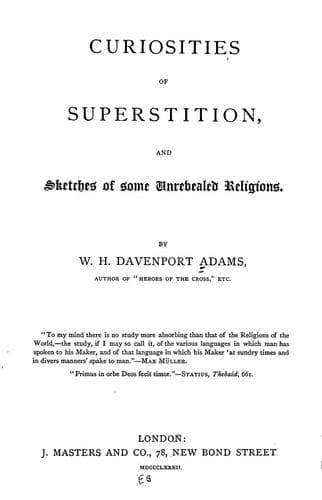
Curiosities of Superstition, and Sketches of Some Unrevealed Religions — John Shaqi
Curiosities of Superstition, and Sketches of Some Unrevealed ReligionsAdams, W. H. Davenport (William Henry Davenport)
Religion
Curiosities of Superstition, and Sketches of Some Unrevealed Religions
Adams, W. H. Davenport (William Henry Davenport)
Folklore; Religions; Superstition
After passing through the four stages of meditation, every Buddhist enters
into the infinity of space; thence rises into the infinity of
intelligence; to soar, afterwards, into the region of Nothing. But even
there he finds no repose; something still remains--the idea of the Nothing
in which he rejoices. This is annihilated in the fourth and last region,
and then he enjoys absolute, perfect rest, “undisturbed by nothing, or
what is not nothing.”
Buddha taught that this Nirvâna--which to most persons will seem a
metaphysical incomprehensibility--could be attained by all men. As there
is no difference between the body of a prince and the body of a beggar, so
is there none between their spirits. Every man is equally capable of
coming to a knowledge of the truth, and if he but _will_ to do so, of
working out his own emancipation.
It is important to observe the absence of any theological element in
Buddhism. Its founder seems never to have spoken of God, and his Nirvâna
is wholly different from the Brahmanic idea of absorption into the Divine
Essence. Of the gods of the people he taught that they were, like men,
subject to the law of Metempsychosis, or Transmigration, and therefore
that as they were unable to deliver, they were unworthy to be worshipped.
A recent writer thinks it would be incorrect to speak of Buddha either as
a theist or an atheist, and asserts that he simply describes a condition
of absolute rest as an escape from the popular metempsychosis, which may
be interpreted either in a theistic or an atheistic sense. But a careful
examination of his system shows, we think, that it was wholly alien to a
belief in a Supreme Spirit.
“Buddhism,” says Barthélémy Saint-Hilaire, “has no God; it has not even
the confused and vague notion of a Universal Spirit, in which the human
soul, according to the orthodox doctrine of Brahmanism, and the Sânkhya
philosophy, may be absorbed. Nor does it admit Nature, in the proper sense
of the word, and it ignores that profound division between spirit and
matter which forms the system and the glory of Kapila. It confounds man
with all that surrounds him, all the while preaching to him the laws of
virtue. Buddhism, therefore, cannot unite the human soul, which it does
not even mention, with a God, whom it ignores; nor with nature, which it
does not know better. Nothing remained but to annihilate the soul; and in
order to be quite sure that the soul may not re-appear under some new
guise in this world, which has been cursed as the abode of illusion and
misery, Buddhism destroys its very elements, and never wearies of glorying
in this achievement. What more is wanted? if this be not the Absolute
Nothing, what is Nirvâna?”
* * * * *
Public-domain text, read in full here on John Shaqi.
Reviews
Reviews
No reviews yet
Be the first to share your thoughts on this work.
Join the Discussion
Join the discussion
Sign in to leave a comment or review.
Sign InorCreate an account