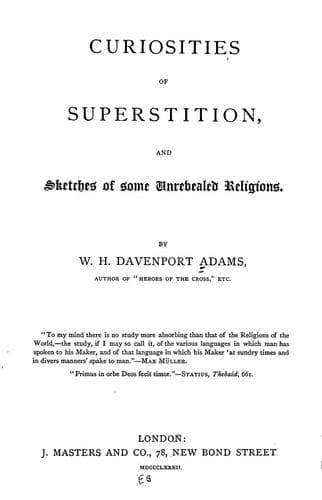
Curiosities of Superstition, and Sketches of Some Unrevealed ReligionsAdams, W. H. Davenport (William Henry Davenport)
Religion
Curiosities of Superstition, and Sketches of Some Unrevealed Religions
Adams, W. H. Davenport (William Henry Davenport)
Folklore; Religions; Superstition
Repellent as seems to us the central doctrine of Buddhism, it extended
rapidly. This extension was due, however, to the simplicity of the ritual
which Buddha enjoined; the pure morality which he advocated; the equality
of all men on which he insisted; and the spirit of love, tenderness,
gentleness, compassion, and toleration which he inspired. Hence it came to
pass that his disciples multiplied in the north-western territories of
Hindustan, and his creed found acceptance, at a later period, probably
about three centuries before CHRIST, all over India. In Ceylon it was
adopted at a very early period; but it was not until the second century
before CHRIST that it made its way into China and Tibet. From Ceylon it
spread into Birmah and Siam, and the islands of the Indian Archipelago,
and from China it penetrated into Japan. It is now the religion of more
than one fifth of the whole human race.
Its influence has been very considerable, and may distinctly be traced in
some of the Gnostic teaching and in the Alexandrine or Neo-Platonic
philosophy. It modified the old Brahmanic religion, which, acting under
its impulse, threw off its human sacrifices and more barbarous rites. The
festival of Juggernaut, which for the time places in abeyance all caste
distinctions, and adopts many Buddhist symbols, shows that the Brahmans,
even when they drove it out of India, were compelled to retain some of
its relics, just as they were under the necessity of recognising Buddha as
one of the Avatars of their god Vishnu. Buddhism may be described as “the
parent of Indian architecture,” which, fashioned at first on the Greek
patterns, speedily assumed a character of its own, as may be seen in its
colossal temples.
But, as is the case with all religious systems of purely human origin,
Buddhism gradually fell away from the standard of its founder. The heart
craves an object of worship, a something or some one on which or on whom
to rest its hopes and fears, and the Buddhists, untaught to reverence a
Supreme Being, transferred their adoration to Buddha himself, whose life
and work they involved in a cloud of myth and legend. His relics came to
be worshipped, and reliquary towers for their preservation were everywhere
erected.
The enthusiasm which fired the Buddhists, and largely contributed to the
rapid extension of their creed, for Buddhism, unlike Brahmanism, is a
proselytising religion, finds a striking illustration in the career of
Hiouen-thsang, the Chinese pilgrim, who, in the middle of the seventh
century, crossed the deserts and mountains which separate China from
India, and visited the principal cities of the Indian Peninsula.
HIOUEN-THSANG, A BUDDHIST PILGRIM.[12]
Public-domain text, read in full here on John Shaqi.
Reviews
Reviews
No reviews yet
Be the first to share your thoughts on this work.
Join the Discussion
Join the discussion
Sign in to leave a comment or review.
Sign InorCreate an account