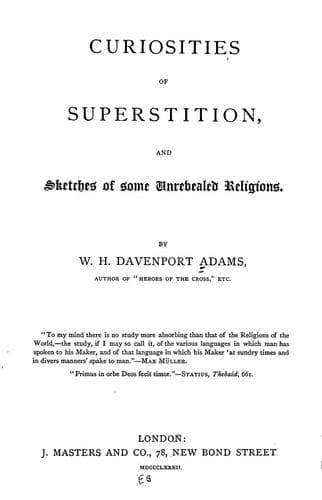
Curiosities of Superstition, and Sketches of Some Unrevealed ReligionsAdams, W. H. Davenport (William Henry Davenport)
Religion
Curiosities of Superstition, and Sketches of Some Unrevealed Religions
Adams, W. H. Davenport (William Henry Davenport)
Folklore; Religions; Superstition
The Indian has a vague idea of God and immortality. He believes in a Great
Spirit, who, after death, admits the brave to his happy hunting-grounds,
where game is inexhaustible, and the pleasure of the chase is ever open to
the hunter. Beyond this dim and dubious conception, his imagination never
carries him.
He is prone, as might be supposed, for such proneness is the cause of
ignorance, and ignorance is the Red Man’s bane, to the wildest and
coarsest superstitions, and he is always at the mercy of the medicine-man
of his tribe. One of his most potent superstitions is that connected with
the “medicine-bag,” which he firmly believes to be his sole “secret of
success,” his all-powerful charm and talisman, without which he would fail
in every undertaking and be defeated and disgraced in battle.
At the age of fourteen or fifteen, the young Indian goes forth into the
woods in search of his medicine. On a litter of leaves and twigs he lies
for some days--as long, in fact, as his physical powers hold out--neither
eating nor drinking; for in proportion to the duration of his fast will be
the potency of his “medicine.” His endurance at length gives way, and he
goes to sleep. The bird, beast, or reptile of which he dreams becomes his
“medicine.” He returns home, and as soon as he has recovered his strength,
he sallies forth in quest of the charm; having found and killed the
animal, he preserves the skin in such shape as his fancy
suggests,--usually in the form of pouch or bag. If small, he slings it
round his neck, and wears it concealed. In other cases, it hangs from his
waist or shoulder.
However he may wear it, the Indian never parts from it. He would be
disgraced and defeated in battle--he would fail in his undertakings--if it
were absent from his person. Should he be deprived of it in battle, he is
overwhelmed with shame, until he can kill an enemy, and take _his_
medicine-bag to replace his own. If, without losing his own, he captures
that of an enemy, he is entitled to assume a “double medicine,” and with
two medicine-bags about him he stalks to and fro, the observed of all
observers. To take a medicine-bag is not less honourable than to take a
scalp, and the successful bearer has all the advantage of the double
protection afforded by the double charm.
Public-domain text, read in full here on John Shaqi.
Reviews
Reviews
No reviews yet
Be the first to share your thoughts on this work.
Elsewhere in the archive
Join the Discussion
Join the discussion
Sign in to leave a comment or review.
Sign InorCreate an account