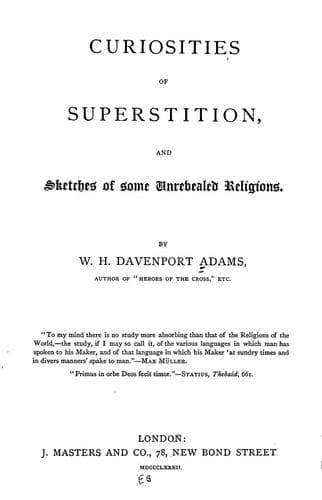
Curiosities of Superstition, and Sketches of Some Unrevealed ReligionsAdams, W. H. Davenport (William Henry Davenport)
Religion
Curiosities of Superstition, and Sketches of Some Unrevealed Religions
Adams, W. H. Davenport (William Henry Davenport)
Folklore; Religions; Superstition
For four nights and five days he traversed the Desert, without a drop of
water to quench his thirst, with no other refreshment than that which he
derived from his prayers; and that these should afford any hope or
consolation seems strange enough, when we remember that Buddhism held out
to him no hope of a God or a Saviour. “It is incredible in how exhausted
an atmosphere the Divine spark within us will glimmer on, and even warm
the dark chambers of the human heart.” Comforted by his prayers, he
resumed his onward march, and in due time arrived at a large lake in the
country of the Oigom Tatars, by whom he was received with an abundant
hospitality. One of the Tatar Khans insisted that he should reside with
him and teach his people; and as he would listen to no remonstrances or
explanations, Hiouen-thsang was driven to a desperate expedient. The king,
he said, might fetter his body, but had no power over his mind and will;
and he refused all food, with a view to put an end to a life which he no
longer regarded as of value. In this resolution he persisted for three
days, and the Khan, afraid that he would perish, was compelled at last to
yield. But he extracted from him a promise that on his return to China he
would visit him, and abide with him for three years. At last, after a
month’s detention, during which the Khan and his court daily attended the
lectures of the pious monk, he resumed his journey, attended by a strong
escort, and furnished with letters of introduction to the twenty-four
princes whose dominions he must cross.
His route lay through what is now called Dsungary, across the
Musur-dabaghan mountains, the northern chain of the Belur-tag, the valley
of the Yaxartes, Bactria, and Kabulistan. The pilgrim’s description of the
scenes through which he passed is interesting and vivid; he was a keen
observer, and gifted with considerable powers of expression.
Of the Musur-dabaghan mountains he says:--
“The crest of these heights rises to the sky. Since the beginning of the
world the snow has been accumulating, and it is now transformed into
masses of ice, which never melt, either in spring or summer. Hard shining
sheets of snow are spread out until they vanish into the infinite, and
mingle with the clouds. If one looks at them, one’s eyes are dazzled by
the splendour. Frozen peaks impend over both sides of the wood, some
hundred feet in height, and some twenty or thirty feet in thickness. It is
not without difficulty and danger that the traveller can clear them or
climb over them. Sudden gusts of hurricane and tornadoes of snow attack
the pilgrims. Even with double shoes, and in thick furs, one cannot help
trembling and shivering.”
Public-domain text, read in full here on John Shaqi.
Reviews
Reviews
No reviews yet
Be the first to share your thoughts on this work.
Join the Discussion
Join the discussion
Sign in to leave a comment or review.
Sign InorCreate an account