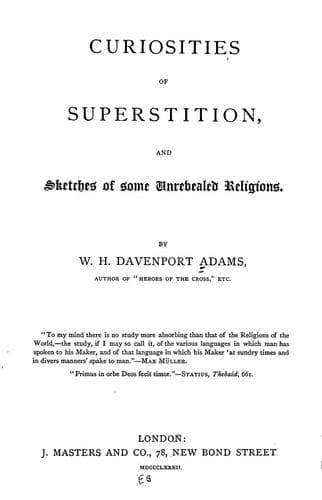
Curiosities of Superstition, and Sketches of Some Unrevealed ReligionsAdams, W. H. Davenport (William Henry Davenport)
Religion
Curiosities of Superstition, and Sketches of Some Unrevealed Religions
Adams, W. H. Davenport (William Henry Davenport)
Folklore; Religions; Superstition
But as Max Müller justly observes, what is more important in the early
portion of our traveller’s narrative than any descriptions of scenery, is
his account of the high degree of civilisation that then obtained among
the tribes of Central Asia. Historians have learned to believe in the
early civilisation of Egypt, Babylon, China, India; but they will have to
abandon all their old ideas of barbarism and barbarians now that they find
the Tatar hordes possessing, in the seventh century, “the chief arts and
institutions of an advanced society.” The theory of M. Oppert, who gives
to a Turanian or Scythian race the original invention of the cuneiform
letters and a civilisation anterior to that of Babylon and Nineveh, ceases
to be improbable; since no new wave of civilisation could have touched
these countries between the cuneiform period of their literature and
history and the epoch of Hiouen-thsang’s visit.[13]
“In the kingdom of Okini, on the western portion of China, Hiouen-thsang
found an active commerce, gold, silver, and copper coinage; monasteries,
where the chief works of Buddhism were studied, and an alphabet derived
from Sanskrit. As he travelled on he met with mines, with agriculture,
including pears, plums, peaches, almonds, grapes, pomegranates, rice, and
wheat. The inhabitants were dressed in silk and woollen materials. There
were musicians in the chief cities who played on the flute and the guitar.
Buddhism was the prevailing religion, but there were traces of an earlier
worship, the Bactrian fire-worship. The country was everywhere studded
with halls, monasteries, monuments and statues. Samarkand formed at that
early time a kind of Athens, and its manners were copied by all the tribes
in the neighbourhood. Balkh, the old capital of Bactria, was still an
important place on the Oxus, well-fortified, and full of sacred buildings.
And the details which our traveller gives of the exact circumference of
the cities, the number of their inhabitants, the products of the soil, the
articles of trade, can leave no doubt in our minds that he relates what he
had seen and heard himself. A new page in the history of the world is here
opened, and new ruins pointed out, which would reward the pickaxe of a
Layard.”
Public-domain text, read in full here on John Shaqi.
Reviews
Reviews
No reviews yet
Be the first to share your thoughts on this work.
Join the Discussion
Join the discussion
Sign in to leave a comment or review.
Sign InorCreate an account