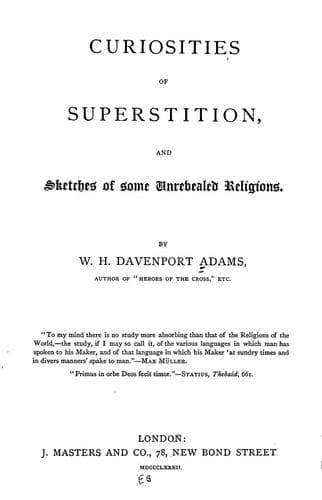
Curiosities of Superstition, and Sketches of Some Unrevealed ReligionsAdams, W. H. Davenport (William Henry Davenport)
Religion
Curiosities of Superstition, and Sketches of Some Unrevealed Religions
Adams, W. H. Davenport (William Henry Davenport)
Folklore; Religions; Superstition
The preservation of health and the prolongation of life are necessarily
objects of interest to all mankind, and it was natural enough that around
them should flourish a rank growth of superstitions.
To ailing or diseased persons all kinds of potions, pills, and powders
were administered in the past as they are in the present; but whereas we
are now content with the mystic characters endorsed on his formula by the
physician, our ancestors were not satisfied unless certain mystical words,
numbers, or ceremonies accompanied them. The sign of the cross was in
constant requisition; or the medicine was to be taken according to
mystical numbers--thrice or nine times, as the case might be. For
hooping-cough was prescribed a draught from the horn of a living ox, nine
times repeated. The patient was also put “nine several times” in the
miller’s hopper.
The importance ascribed to the figure of a circle is probably a relic of
the influence of the old sun-worship. Consumptive invalids, or children
suffering from hectic fever, were thrice passed through a circular wreath
of woodbine, cut during the increase of the March moon, and let down over
the body from head to foot. We read of a sorceress who healed sundry women
by “taking a garland of green woodbine, and causing the patient to pass
thrice through it.” Afterwards, the garland was cut in nine pieces, which
were cast into the fire--generally an indispensable particular in
ceremonies of this kind. Another passed her patient through a heap of
green yarn, which the nurse shook, and then divided it into nine pieces,
which were buried in the lands of three owners. A certain Thomas Grieve
directed a patient to pass thrice through a heap of yarn, which he duly
burned. He also cured the wife of a Michael Glanis by having a hole broken
on the north side of the chimney, and putting a hoop of yarn thrice
through it, and taking it back at the door; and thereafter compelling the
patient to go nine times through the said hoop of yarn.
White of Selborne tells us of a custom, prevalent in his time in the south
of England, of stripping feeble and diseased children, and transmitting
them head foremost through an artificial cleft in a young tree, the
several parts of which were held forcibly asunder. The wound was then
bound up carefully, and it was expected that the child would recover as
the tree healed. If the cleft did not unite, the remedy proved abortive;
and if the tree were cut down, the patient relapsed or died.
Borlase speaks of a similar custom in Cornwall, except that a perforated
stone was used instead of a cleft tree.
Public-domain text, read in full here on John Shaqi.
Reviews
Reviews
No reviews yet
Be the first to share your thoughts on this work.
Elsewhere in the archive
Join the Discussion
Join the discussion
Sign in to leave a comment or review.
Sign InorCreate an account