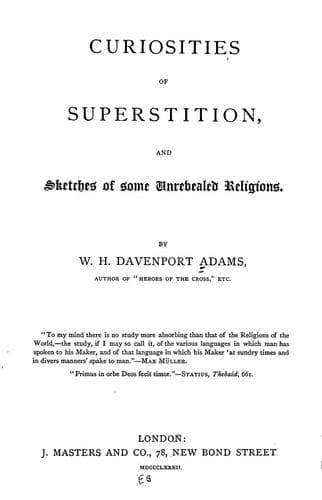
Curiosities of Superstition, and Sketches of Some Unrevealed ReligionsAdams, W. H. Davenport (William Henry Davenport)
Religion
Curiosities of Superstition, and Sketches of Some Unrevealed Religions
Adams, W. H. Davenport (William Henry Davenport)
Folklore; Religions; Superstition
In Persia, according to Alexander, passage through a long fissure or
crevice in a rock, by crawling on hands and knees, is employed as a test
of legitimate birth. And in the Church of the Holy Sepulchre at Jerusalem,
to pass between the pillars supporting an altar and the neighbouring wall,
was practised as a like test. It has been suggested, as the meaning of
these various transmissions through cleft, aperture, skein of yarn, and
garland, that they are symbolical of regeneration; a second birth, whereby
a living soul is cleansed from its former impurities and imperfections.
Wilford speaks of a sanctified fissure in a rock in the East, to which
pilgrims resort “for the purpose of regeneration, by the efficacy of a
passage through this sacred type.”
* * * * *
The faculty of divining events, passing at a distance from the seer, or of
passively receiving a knowledge that such events are taking place, is the
well-known “second sight,” which plays so important a part in many
Scottish stories. “In the stricter acceptation of this faculty,” we are
told, “contemporary objects and incidents are beheld at the time, however
remote their locality, but neither those which have passed, nor those
which have yet to come. If extending to futurity, the subject of the
vision is about to be realised. Therefore the second sight borders only on
prognostication. It is affirmed to be more peculiar to Scotland, for very
faint analogy to such a property has been claimed for other countries: and
that the highlanders chiefly, together with the inhabitants of the insular
districts, or that portion of the kingdom less advanced, have enjoyed it
in the highest perfection. Marvellous to be told, they have said that
their cattle are gifted with it as well as themselves.”
The faculty was one which knew no distinction of age or sex, or class; it
was enjoyed by man and woman, young and old, rich and poor, high-born and
plebeians, and in many cases was inherited. It might occasionally be
imparted by a gifted person, or acquired by study and preparation. It is a
proof, were proof needed, of the living influence of the imagination, that
the vision beheld by one individual only, might be revealed to a companion
visionary, thus confirmed in his belief in the value of his new
prerogative; simply by the pressure of the seer’s right foot on the
novice’s left, holding one hand on his head, while he was admonished to
look over the master’s right shoulder. Thus, Lilly, the
astrologer--Butler’s “hight Sidrophel”--relates how one John Scott desired
William Hodges, an astrologer in Staffordshire, to show him the person and
features of the person he should marry. Hodges carried him into a field
not far from his home; pulled out his magic crystal; bade Scott set his
foot against his, and after awhile desired him to inspect the crystal, and
observe what he saw there. Of course he saw exactly what his fevered
wishes were resolved to see.
Public-domain text, read in full here on John Shaqi.
Reviews
Reviews
No reviews yet
Be the first to share your thoughts on this work.
Elsewhere in the archive
Join the Discussion
Join the discussion
Sign in to leave a comment or review.
Sign InorCreate an account