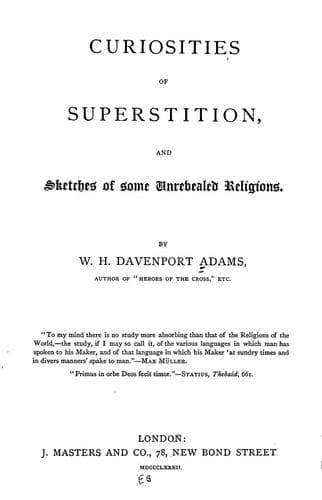
Curiosities of Superstition, and Sketches of Some Unrevealed ReligionsAdams, W. H. Davenport (William Henry Davenport)
Religion
Curiosities of Superstition, and Sketches of Some Unrevealed Religions
Adams, W. H. Davenport (William Henry Davenport)
Folklore; Religions; Superstition
It is probable that this ceremony is the relic of some ancient form of
ritual. At all events, the skins of animals played an important part in
the old worship. When the Thebans slew a cow on the festival of Jupiter
Ammon, his image was clothed with the skin: all present in the temple then
struck the carcase, which was buried in a consecrated place.
Pausanias records that a temple in honour of the soothsayer Amphiaraus,
the reputed son of Apollo, stood in the territory of Oropus in Attica.
Votaries who resorted thither for the purpose of divination, underwent
certain lustrations, or purifying rites, sacrificed a ram, and, in
expectation of seeing visions, slept upon its skin.
Virgil, in one of the most elaborate scenes of the Æneid, represents to us
a similar oblation as being offered at a consecrated fountain, where the
priest, to prepare himself for the delivery of responses, slept on the
skin:--
“Et cæsarum ovium sub nocte silenti
Pellibus incubuit stratis, somnosque petivit;
Multa modis simulacra videt volitantia miris
Et varias audit voces.”[72]
It seems to have been an important part of the heathen ritual to make use
of the skin of the sacrificed animal for the purposes of clothing. Lucian,
describing the ceremonies practised in the temple of Hierapolis, says
that, on his arrival, the head and eyebrows of the novice were shaved; a
sheep was then sacrificed; he knelt on the skin, and covering his own head
with the head and feet of the animal, prayed that his offering might be
accepted while promising a worthier one.
The Spanish invaders of the New World discovered that the religion of its
most civilised race, the Aztecs, was founded upon human sacrifices. The
number of victims offered up to the Aztec gods is stated in figures which
seem almost incredible. Peculiar to the Aztec kingdom was the horrid
ceremony entitled “the flaying of men.” The Aztecs having demanded the
daughter of some neighbouring potentate as their queen, she was flayed on
the very night of her arrival by command of their deity, and a young man
clothed in her skin. In this originated the custom that a captive slave,
distinguished by the name, the honours, and the ornaments of the divinity,
should be sacrificed after a certain time; and another, clothed with his
skin, then exacted contributions for the service of the gods, which no
one, says Acosta, dared to refuse.
* * * * *
We have no space to dwell on the various forms of divination that were
wont to prevail. Almost everything in nature, from the stars of heaven to
the clods of earth, was made to give indications of coming events. The
historian of the darker Superstitions of Scotland brings together a few
striking illustrations.
Public-domain text, read in full here on John Shaqi.
Reviews
Reviews
No reviews yet
Be the first to share your thoughts on this work.
Elsewhere in the archive
Join the Discussion
Join the discussion
Sign in to leave a comment or review.
Sign InorCreate an account