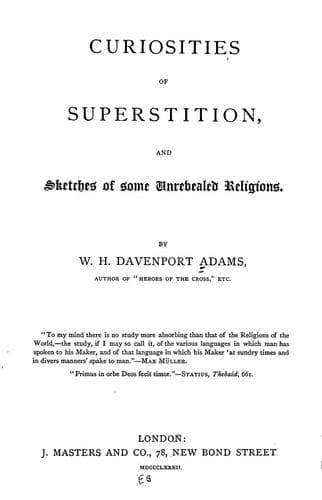
Curiosities of Superstition, and Sketches of Some Unrevealed Religions — John Shaqi
Curiosities of Superstition, and Sketches of Some Unrevealed ReligionsAdams, W. H. Davenport (William Henry Davenport)
Religion
Curiosities of Superstition, and Sketches of Some Unrevealed Religions
Adams, W. H. Davenport (William Henry Davenport)
Folklore; Religions; Superstition
Hiouen-thsang resumed his journey, with his guide, and passed a stream
which rushed tumultuously between the walls of a precipitous ravine. In
the rock was a door opening into a depth of darkness. With a fervent
prayer the pilgrim entered boldly, advanced towards the east, then moved
fifty steps backwards, and began his devotions. He made one hundred
salutations, but saw nothing. This he conceived to be a punishment for his
sins; he reproached himself despairingly and wept bitter tears, because he
was denied the happiness of seeing Buddha’s shadow. At last, after many
prayers and invocations, he saw on the eastern wall a dim patch of light.
But it passed away. With mingled joy and pain he continued to pray, and
again he saw a light, and again it vanished swiftly. Then, in his ecstasy
of loving devotion, he vowed that he would never leave the place until he
had seen the “Venerable of the age.” After two hundred prayers, he saw the
cave suddenly fill with radiance, and the shadow of Buddha, of a brilliant
white colour, rose majestically on the wall, as when the clouds are riven,
and all at once flashes on the wondering eye the marvellous image of the
“Mountain of Light.” The features of the divine countenance were
illuminated with a dazzling glow. Hiouen-thsang was absorbed in wondering
contemplation, and from an object so sublime and incomparable he could not
turn his eyes away.
After he awoke from his trance, he called in six men, and bade them kindle
a fire in the cave, that he might burn incense; but as the glitter of the
flame made the shadow of Buddha disappear, he ordered it to be
extinguished. Five of the attendants saw the shadow, but the sixth saw
nothing; and the guide, when Hiouen-thsang told him of the vision, could
only express his astonishment. “Master,” he said, “without the sincerity
of your faith and the energy of your vows, you could not have seen such a
miracle.”
Such is the account which Hiouen-thsang’s biographers give of his visit to
Buddha’s cave; but Max Müller remarks, to the credit of Hiouen-thsang
himself, that in the _Si-yu-hi_, which contains his own diary, the story
is told much more simply. After describing the cave, he merely
adds:--“Formerly, the shadow of Buddha was seen in the cave, bright, like
his natural appearance, and with all the marks of his divine beauty. One
might have said, it was Buddha himself. For some centuries, however, it
has not been possible to see it completely. Though one does perceive
something, it is only a feeble and doubtful resemblance. If a man prays
with sincere faith, and if he have received from above a secret
impression, he sees the shadow clearly, but cannot enjoy the sight for any
length of time.”
* * * * *
Public-domain text, read in full here on John Shaqi.
Reviews
Reviews
No reviews yet
Be the first to share your thoughts on this work.
Join the Discussion
Join the discussion
Sign in to leave a comment or review.
Sign InorCreate an account