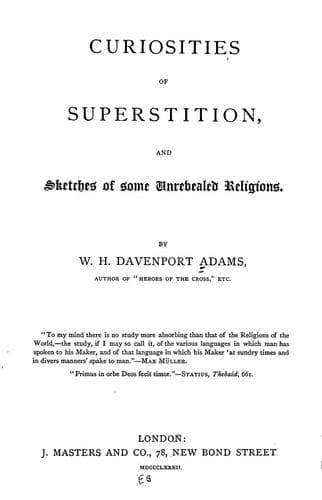
Curiosities of Superstition, and Sketches of Some Unrevealed ReligionsAdams, W. H. Davenport (William Henry Davenport)
Religion
Curiosities of Superstition, and Sketches of Some Unrevealed Religions
Adams, W. H. Davenport (William Henry Davenport)
Folklore; Religions; Superstition
From Peshawer the undaunted pilgrim proceeded to Kashmir, visited the
principal towns of Central India, and arrived at last in Magadha, the Holy
land of the Buddhists. There, for a space of five years, he devoted
himself to the study of Sanskrit and Buddhist literature; he explored
every place which was consecrated by memories of the past. Passing through
Bengal, he travelled southward, with the view of visiting Ceylon, the
chief seat of Buddhism. But, unable to carry out his design, he crossed
the peninsula from east to west, ascended the Malabar coast, reached the
Indus, and after numerous excursions to scenes of interest in
North-Western India, returned to Magadha to enjoy, with his old friends,
the delights of learned leisure and intellectual companionship.
Eventually, his return to China became necessary, and traversing the
Punjab, Kabulistan, and Bactria, he struck the river Oxus, following its
course nearly up to its springhead on the remote Pamir tableland; and
after a residence of some duration in the three chief towns of Turkistan,
Khasgar, Yarkand, and Khoten, he found himself again, after sixteen years
of varied experience, in his native land. By this time he had attained a
world-wide reputation, and he was received by the Emperor with the honours
usually accorded to a military hero. His entry into the capital was marked
by public rejoicings; the streets were decked with gay carpets, festoons
of flowers, and waving banners. The splendour of martial pomp was not
wanting; the civic magistrates lent the dignity of their presence to the
scene; and all the monks of the district issued forth in solemn
procession.
If this were a triumph of unusual character, not less unaccustomed were
the trophies which figured in it.
First, 150 grains of Buddha’s dust;
Second, a golden statue of Buddha;
Third, another statue of sandal-wood;
Fourth, a statue of sandal-wood, representing Buddha as descending from
heaven;
Fifth, a statue of silver;
Sixth, a golden statue, representing Buddha victorious over the dragon;
Seventh, a statue of sandal-wood, representing Buddha as a preacher; and
Eighth, a collection of 657 Buddhist works in 520 volumes.
* * * * *
Public-domain text, read in full here on John Shaqi.
Reviews
Reviews
No reviews yet
Be the first to share your thoughts on this work.
Join the Discussion
Join the discussion
Sign in to leave a comment or review.
Sign InorCreate an account