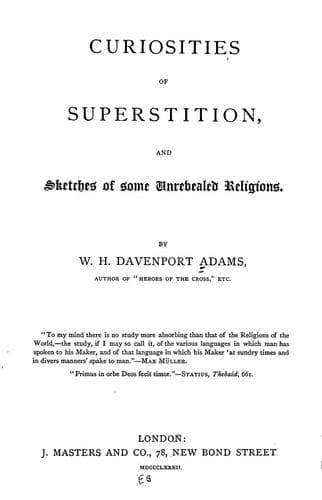
Curiosities of Superstition, and Sketches of Some Unrevealed Religions — John Shaqi
Curiosities of Superstition, and Sketches of Some Unrevealed ReligionsAdams, W. H. Davenport (William Henry Davenport)
Religion
Curiosities of Superstition, and Sketches of Some Unrevealed Religions
Adams, W. H. Davenport (William Henry Davenport)
Folklore; Religions; Superstition
Admitted to an audience of the Emperor in the Phœnix Palace, he was
offered, but declined, a high position in the Government. “The doctrine of
Confucius,” he said, “is still the soul of the administration;” and he
preferred to devote his remaining years to the study of the Law of Buddha.
The Emperor invited him to write a narrative of his travels, and placed at
his disposal a monastery where he might employ himself in peaceful and
happy seclusion in translating the works he had brought back from India.
He quickly wrote and published his travels, but the translation of the
Sanskrit MSS. occupied the rest of his life. It is said that the number of
the works he translated, with the assistance of a large staff of monks,
amounted to 740, in 1335 volumes. Often he might be seen pondering a
passage of difficulty, when suddenly a flash of inspiration would seem to
enlighten his mind. His soul was cheered, as when a man walking in
darkness sees all at once the sun piercing the clouds and shining in its
full brightness; and, unwilling to trust to his own understanding, he used
to attribute his knowledge to a secret inspiration of Buddha and the
Bôdhisattvas.
When his last hour approached, he divided all his property among the poor,
invited his friends to come and see him, and take a cheerful farewell of
the impure body of Hiouen-thsang. “I desire,” he said, “that whatever
merits I may have gained by good works may fall upon other people. May I
be born again with them in the heaven of the blessed, be admitted to the
family of Mi-le, and serve the Buddha of the future, who is full of
kindness and affection. When I descend again upon earth to pass through
other forms of existence, I desire at every new birth to fulfil my duties
towards Buddha, and arrive at the last at the highest and most perfect
intelligence.” He died in the year 664.
The life of Hiouen-thsang, and his narrative of travel, have been
translated into French by M. Stanislas Julien.[14] The foregoing
particulars have been borrowed from a review of M. Julien’s work, by Max
Müller, which originally appeared in the “Times” of April 17 and 20, 1857.
We translate from Stanislas Julien’s “Vie et Voyages de Hiouen-thsang” the
Chinese narrative of the pilgrim’s last days:--
“After completing his translation of the Pradjñâ, the Master of the Law
became conscious that his strength was failing, and that his end was near
at hand. Accordingly he spoke to his disciples: ‘If I came into the palace
of Yu-hoa-kong, it was, as you know, on account of the sacred book of the
Pradjñâ. Now that the work is finished, I feel that my thread of life is
run out. When after death you remove me to my last resting-place, see that
everything be done in a modest and simple manner. You will wrap my body
in a mat, and deposit it in some calm and solitary spot in the bosom of a
valley. Carefully avoid the neighbourhood of palace or convent; a body so
impure as mine should be separated from it by a great distance.’
Public-domain text, read in full here on John Shaqi.
Reviews
Reviews
No reviews yet
Be the first to share your thoughts on this work.
Join the Discussion
Join the discussion
Sign in to leave a comment or review.
Sign InorCreate an account