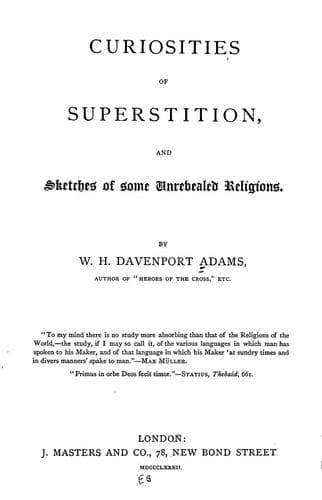
Curiosities of Superstition, and Sketches of Some Unrevealed ReligionsAdams, W. H. Davenport (William Henry Davenport)
Religion
Curiosities of Superstition, and Sketches of Some Unrevealed Religions
Adams, W. H. Davenport (William Henry Davenport)
Folklore; Religions; Superstition
“He had another dream on the seventeenth day, in which he saw hundreds and
thousands of men of tall stature, who, decorated with garments of
embroidered silk, with flowers of marvellous beauty, and jewels of great
price, issued from the sleeping-chamber of the Master of the Law, and
proceeded to set out, both internally and externally, the hall consecrated
to the translation of the holy books. Afterwards, in the rear of that
hall, on a wooded mountain, they everywhere planted rich banners of the
most vivid colours, and created an harmonious music. He saw moreover,
without the gate, an innumerable multitude of splendid chariots loaded
with perfumed viands and fruits of more than a thousand kinds, as
beautiful in form as in colour; no fruits were there of terrestrial
growth! The people brought them to him, one after the other, and offered
him a profusion; but he refused them, saying: ‘Such viands as these belong
only to those who have obtained the superior intelligence. Hiouen-thsang
has not yet arrived at that sublime rank: how could he dare to receive
them?’ In spite of his energetic refusal they continued to serve him
without intermission.
“The disciples who watched by him happening to make some slight sound, he
opened his eyes suddenly, and related his dream to the sub-director
(_Karmmadana_), a certain Hoeï-te.”
“‘And from these omens,’ added the Master, ‘it seems to me that such
merits as I have been able to acquire during my life have not fallen into
oblivion, and I believe, with an entire faith, that it is not in vain one
practises the doctrine of the Buddha.’
“Immediately, he ordered the master Kia-chang to make a written list of
the titles of the sacred books and the treatises which he had translated,
forming altogether seven hundred and forty works and thirteen hundred and
thirty-five volumes (_livres_). He wrote down also the _Kôti_ (ten
millions) of paintings of the Buddha, as well as the thousand images of
_Mi-le_ (_Mâitrêya bôdhisattva_), painted on silk, which he had caused to
be executed. There were, moreover, the _Kôtis_ (one hundred millions) of
statuettes of uniform colour. He had also caused to be written a thousand
copies of the following sacred books:
_Nong-touan-pan-jo-king (Vadjra tchhêdika pradjñâ parâmitâ soûtra)._
_Yo-sse-jou-laï-pou-youen-kong-te-king (Arya bhagavati bhâichadja
gourou poûrwa pranidhâna nâma mahâ yâna soûtra)._
_Lou-men-t’o-lo-ni-king (Chat moukhi dhârani)._”
He had ministered to the wants of upwards of twenty thousand persons among
the faithful and heretical; he had kindled a hundred thousand lamps, and
purchased thousands upon thousands (_ocean_) of creatures.
Public-domain text, read in full here on John Shaqi.
Reviews
Reviews
No reviews yet
Be the first to share your thoughts on this work.
Join the Discussion
Join the discussion
Sign in to leave a comment or review.
Sign InorCreate an account