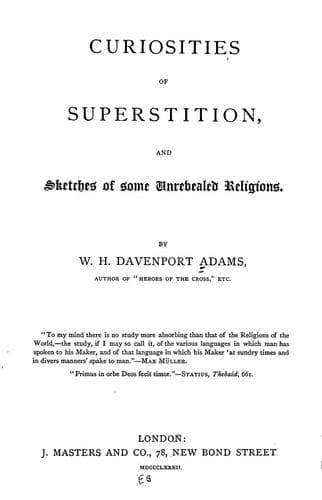
Curiosities of Superstition, and Sketches of Some Unrevealed ReligionsAdams, W. H. Davenport (William Henry Davenport)
Religion
Curiosities of Superstition, and Sketches of Some Unrevealed Religions
Adams, W. H. Davenport (William Henry Davenport)
Folklore; Religions; Superstition
When Kia-chang had finished this long catalogue of good works, he was
ordered to read it aloud. After hearing it, the religious crossed their
hands and loaded the Master with congratulations. Then he said to
them:--“The moment of my death approaches; already my mind grows feeble
and seems to be on the point of quitting me. Distribute at once in alms my
clothes and goods; let statues be fabricated; and order the religious to
recite some prayers.”
On the twenty-third day, a meal was given to the poor, at which alms were
distributed. On the same day, he ordered a moulder named Song-kia-tchi, to
raise, in the Kia-cheou-tien palace, a statue of the Intelligence
(Buddha); after which he invited the population of the convent, the
translators, and his disciples, to bid “a joyous farewell to that impure
and contemptible body of Hiouen-thsang, who, having finished his work,
merited no longer existence. I desire,” he added, “to see poured back upon
other men the merits which I have acquired by any good works; to be born
with them in the heaven of the Touchitas; to be admitted into the family
of _Mi-le_ (_Mâitrêya_); and to serve the Buddha, full of tenderness and
affection. When I shall return to earth to pass through other existences,
I desire, at each new birth, to discharge with boundless zeal my duties
towards the Buddha, and finally to arrive at the Transcendent Intelligence
(_Anouttara samyak sambôdhi_).”
After having made these adieux, he was silent, and engaged in meditation;
then with his dying tongue he faltered forth his bitter regret that he did
not enjoy more of the “world of the eyes” (the faculty of seeing), of the
“world of the thought” (the faculty of thinking), of “the world of the
knowledge which springs from observation” (the knowledge of sensible
objects); of the “world of the knowledge which springs from the
mind”--_l’esprit_ (the perception of spiritual things); and that he did
not possess the fulness of the Intelligence. Finally, he pronounced two
_gubhas_, which he caused to be repeated to the persons near him:--
“Adoration to _Maitrêya Tathagata_, gifted with a sublime intelligence! I
desire, with all men, to see your affectionate visage.
“Adoration to _Maitrêya Tathagata_! I desire, when I quit this life, to be
born again in the midst of the multitude who surround you.”
The Master of the Law, after having long fixed his gaze upon Te-hoeï, the
sub-director of the convent (_Karmmadana_), raised his right hand to his
chin and his left upon his breast; then he stretched out his legs, crossed
them, and lay down on the right side.
He remained thus, immovable, without taking anything, until the fifth day
of the second moon. In the middle of the night his disciples asked him:
“Master, have you at length obtained to be born in the midst of the
assembly of _Maitrêya_?”
“Yes,” he replied, with a failing voice. And having spoken, his breathing
grew rapidly weaker, and in a few moments, his soul passed away.
Public-domain text, read in full here on John Shaqi.
Reviews
Reviews
No reviews yet
Be the first to share your thoughts on this work.
Join the Discussion
Join the discussion
Sign in to leave a comment or review.
Sign InorCreate an account