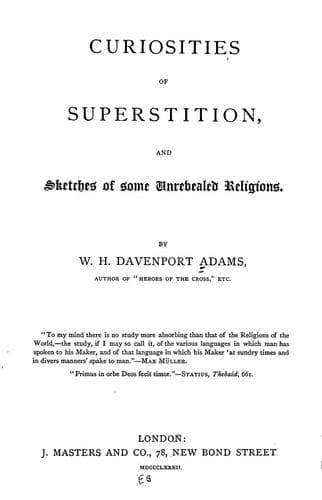
Curiosities of Superstition, and Sketches of Some Unrevealed ReligionsAdams, W. H. Davenport (William Henry Davenport)
Religion
Curiosities of Superstition, and Sketches of Some Unrevealed Religions
Adams, W. H. Davenport (William Henry Davenport)
Folklore; Religions; Superstition
“What a misfortune for my empire is the loss of Thsang, the Master of the
Law! It may well be said that the great family of Cakya has seen its sole
support shattered beneath it, and that all men remain without master and
without guide. Do they not resemble the mariner who sees himself sinking
into the abyss, when the storm has destroyed his oars and his shallop? the
traveller astray in the midst of the darkness, whose lamp dies out at the
entrance to a bottomless gulf?”
When he had uttered these words, the Emperor groaned again, and sighed
many times.
On the twenty-sixth day of the same month, the Emperor issued the
following decree:
“In accordance with a report addressed to me by Teou-sse-lun on the death
of the Master of the Law, Hiouen-thsang, of the convent _Yu-hoa-sse_, I
order that his funeral take place at the expense of the State.”
On the sixth day of the third moon, he issued a new decree as follows:
“By the death of Thsang, the Master of the Law, the translation of the
sacred books is stopped. In conformity to the ancient ordinances, the
magistrates will cause the translations already completed to be copied
carefully: as for the (Indian) manuscripts which have not yet been
translated, they will be handed over in their entirety to the director of
the convent _Ts’e’-en-sse_ (of the Great Beneficence,) who will watch over
their safety. The disciples of Hiouen-thsang and the translators’ company,
who previously did not belong to the convent _Yu-hoa-sse_, will all return
to their respective convents.”
On the fifth day of the third moon appeared the following decree:
“On the day of the funeral of the Master of the Law, Hiouen-thsang, I
permit the male and female religious of the capital to accompany him _with
banners and parasols_ to his last resting-place. The Master of the Law
shone by his noble conduct and his eminent virtues, and was the idol of
his age. Wherefore, now he is no more, it is just that I should diffuse
again abundant benefits to honour the memory of a man who has had no equal
in past times.”
His disciples, faithful to his last wishes, formed a litter of coarse
mats, removed his body to the capital, and deposited it in the convent of
the Great Beneficence, in the middle of the hall devoted to the labours
of translation. United by the sentiment of a common sorrow, they uttered
such cries as might have shaken the earth. The religious and the laics of
the capital hastened to the spot, and poured out tears mingled with sobs
and cries. Every day the crowd was swollen by fresh arrivals.
Public-domain text, read in full here on John Shaqi.
Reviews
Reviews
No reviews yet
Be the first to share your thoughts on this work.
Join the Discussion
Join the discussion
Sign in to leave a comment or review.
Sign InorCreate an account