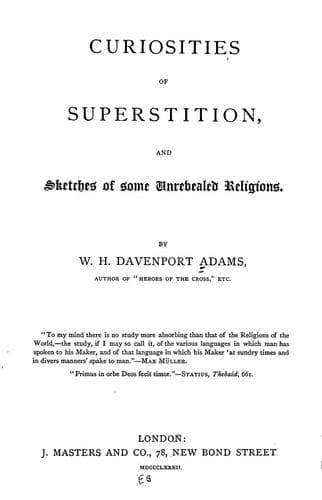
Curiosities of Superstition, and Sketches of Some Unrevealed ReligionsAdams, W. H. Davenport (William Henry Davenport)
Religion
Curiosities of Superstition, and Sketches of Some Unrevealed Religions
Adams, W. H. Davenport (William Henry Davenport)
Folklore; Religions; Superstition
His servants, feeling quietly, found that his feet were already cold, but
that the back part of the head retained its warmth.
On the seventh day (of the second moon) his countenance had not undergone
any alteration, and his body exhaled no odour.
The religious of the convent having passed several days in prayers, it was
not until the morning of the ninth day that the sad news reached the
capital.
* * * * *
The Master of the Law was seven _tchi_ high; his face was of a fresh
complexion. His eyebrows were wide apart, his eyes brilliant. His air was
grave and majestic, and his features were full of grace and vivacity. The
quality or tone (_timbre_) of his voice was pure and penetrating, and his
language at times soared to a lofty eloquence, so noble and so harmonious
that one could not refuse to listen. When he was surrounded by his
disciples, or animated by the presence of an illustrious guest, he would
often speak for half-a-day, while his hearers sat riveted in an immovable
attitude. His favourite attire was a robe of fine cotton stuff,
proportioned to his height and figure; his gait was light and easy; he
looked straight before him, throwing his glances neither to the right nor
to the left. He was majestic as those great rivers which embrace the
earth; calm and shining as the lotus which springs in the midst of the
waters. A severe observer of discipline, he was unchanged and
unchangeable. Nothing could equal his affectionate benevolence and tender
pity, the fervour of his zeal or his inviolable attachment to the
practices of the Law. He was reserved in his friendship, made no hasty
bonds, and when once he had entered his convent, nothing but an imperial
decree could have drawn him from his pious retreat.
On the third day of the second moon (of the period _Lin-te_,--664), the
Master of the Law had sent Hiu-hiouen-pi to inform the Emperor of the
wound he had received, and of the malady it had induced.
On the seventh day of the same month the Emperor, by a decree, ordered one
of the imperial physicians to take with him medicaments and attend upon
the Master of the Law, but by the time he arrived, the Master was already
dead. Teou-sse-lun, governor of Fang-tcheou, announced by a report this
melancholy event.
At the news, the Emperor shed tears copiously, and cried aloud in his
sorrow, declaring that he had just lost the treasure of the empire. For
several days he suspended the usual audiences.
All the civil and military functionaries abandoned themselves to groans
and tears: the Emperor himself was unable to repress his sobs or moderate
his grief. On the next day but one, he spoke to his great officers as
follows:
Public-domain text, read in full here on John Shaqi.
Reviews
Reviews
No reviews yet
Be the first to share your thoughts on this work.
Join the Discussion
Join the discussion
Sign in to leave a comment or review.
Sign InorCreate an account