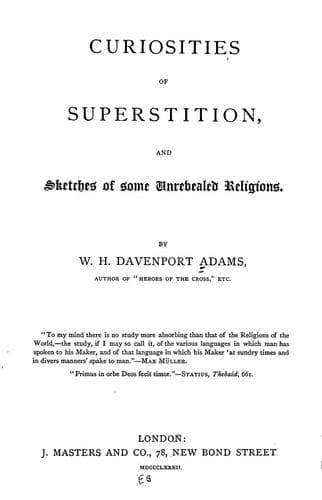
Curiosities of Superstition, and Sketches of Some Unrevealed Religions — John Shaqi
Curiosities of Superstition, and Sketches of Some Unrevealed ReligionsAdams, W. H. Davenport (William Henry Davenport)
Religion
Curiosities of Superstition, and Sketches of Some Unrevealed Religions
Adams, W. H. Davenport (William Henry Davenport)
Folklore; Religions; Superstition
We propose to furnish in this chapter a general view of the construction
and teaching of the Parsee Scriptures, with the view of showing the signal
inferiority of the creed it embodies to Christianity in all that can
elevate the mind and satisfy the soul. At the same time we admit that the
Parsee creed, and all similar creeds, possess an intrinsic value, apart
from their ethical deficiencies, as illustrating the recognition of an
Almighty Will, an Eternal and Supreme Force, by all the higher races of
mankind. They show us the hopes, fears, and desires of great tribes and
peoples which existed in the days before men wrote history; and they show
us how their wisest teachers groped in the dark, and stumbled in the
thorny path,--favoured occasionally, it is true, with a wonderful glimpse
of light, and striking now and again into the pleasant places, but never
rejoicing in the glory which rose upon earth with the Sun of
Righteousness, never treading in that narrow but secure way which leads to
Eternal Life. We see in them the great minds of the early world, like
children on the seashore, perplexed by a music which they could not
comprehend, and astonished by a power which they were unable to define.
Yet happier and wiser they than the cold materialist of a later age, who
resolves all mysteries, all phenomena, into the working of a blind
inflexible Law, and takes out of creation its light, beauty, and joy by
denying the existence of an all-powerful and all-loving Creator.
The religion professed by the ancient Persians, and still accepted by the
Parsees of Western India, and by a scattered population in Yezd and
Kerman, is taught in the books known as the Zend-Avesta. This title comes
from the Sassanian term _Avesta_ or _Apusta_, that is, the text;[17] and
_Zend_, or _Zand_, that is, the commentary upon it. The meaning of the
latter word, however, seems to have varied at different periods.
Originally it signified the interpretation of the sacred texts handed down
from Zoroaster (or Zarathustra) and his disciples. In course of time the
interpretation came to be esteemed not less authoritative and sacred than
the original text, and both were called _Avesta_. But the language in
which they were written having died out, they became unintelligible to the
majority of the people, and a new _Zend_ or commentary was required before
they could be understood. The new “Zend” was the work of the most learned
priests of the Sassanian period, and consisted of a translation of the
double “Avesta” into the vernacular language then in vogue.[18] And as
this translation is the only key which the priests of modern Persia
possess to the old creed as taught by Zarathustra, it has usurped the
place of the original Zend, and is now the recognised official commentary.
Public-domain text, read in full here on John Shaqi.
Reviews
Reviews
No reviews yet
Be the first to share your thoughts on this work.
Join the Discussion
Join the discussion
Sign in to leave a comment or review.
Sign InorCreate an account