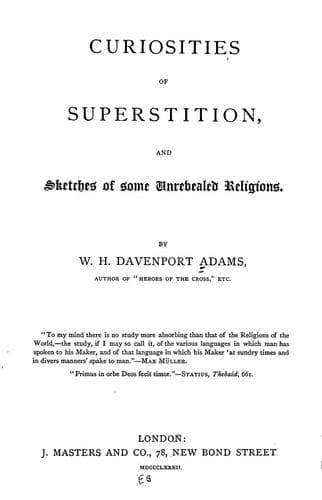
Curiosities of Superstition, and Sketches of Some Unrevealed ReligionsAdams, W. H. Davenport (William Henry Davenport)
Religion
Curiosities of Superstition, and Sketches of Some Unrevealed Religions
Adams, W. H. Davenport (William Henry Davenport)
Folklore; Religions; Superstition
But, anciently, the word “Zend” implied something more than a simple
interpretation of the “Avesta,” or sacred texts. That interpretation was
the source of certain new doctrines, the whole of which were considered
orthodox, and designated _Zandi-agahi_, or Zend doctrines; doctrines
which, it can hardly be doubted, supplied Plutarch and some other of the
Greeks with ethical suggestions. The name _Pazend_, which frequently
occurs in connection with _Avesta_ and _Zend_, denotes a further
exposition of Zarathustrian teaching, as contained in the Vendidad, to
which we shall shortly refer.
Thus far we have been indebted to Dr. Haug’s account of the origin of the
Zendavesta. His views are confirmed by Westergaard, who asserts that the
sacred books belong to two epochs; that is, that they are written in one
age, and collected and systematised in another, in much the same way as,
according to Wolf, the Homeric poems were produced and assumed their
present form. All the earlier traditions ascribe their origin to
Zarathustra; but modern philologists affirm that they could not have
sprung from any single mind, because they present no defined or
self-consistent system of religious belief or moral economy. Like the
hymns of the Vedas, and the strains of the Norse Edda, the several
portions of the Zendavesta, so they say, must have been composed by
different bards, each of whom coloured his particular theme according to
the hues of his lively imagination. This theory, however, though it may
have an element of truth in it, is hardly the whole truth. The Zendavesta
is unquestionably wanting in unity and completeness. But it seems to us
that traces of a dominant mind are everywhere visible; that the various
parts are held together as on a thread by the teaching of Zarathustra
himself; and that the additions made by later and inferior writers are not
such as wholly to obscure the original work.
Public-domain text, read in full here on John Shaqi.
Reviews
Reviews
No reviews yet
Be the first to share your thoughts on this work.
Join the Discussion
Join the discussion
Sign in to leave a comment or review.
Sign InorCreate an account