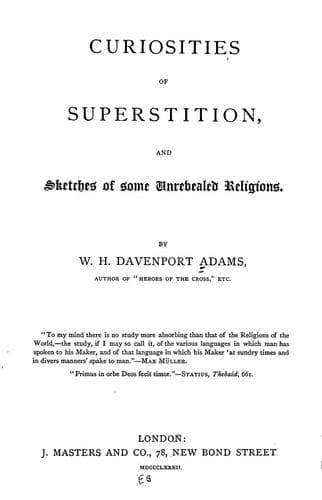
Curiosities of Superstition, and Sketches of Some Unrevealed Religions — John Shaqi
Curiosities of Superstition, and Sketches of Some Unrevealed ReligionsAdams, W. H. Davenport (William Henry Davenport)
Religion
Curiosities of Superstition, and Sketches of Some Unrevealed Religions
Adams, W. H. Davenport (William Henry Davenport)
Folklore; Religions; Superstition
According to Miss Cumming, who is confirmed by other travellers, the
cylinders vary in size, from tiny hand-mills, about as big as a
policeman’s rattle, to huge machines, eight or ten feet in diameter,
worked by a heavy iron crank, or sometimes by wind or water power. The
wind prayer-mills are turned by wings, which, like the cylinder, are
plentifully covered with prayers. The water-mills are placed over streams,
so as to dispense with human aid, and allow the running water to turn them
for the general welfare of the village. Through the cylinder passes a
wooden axle, which is fastened to a horizontal wheel, whose cogs are
turned diagonally to the water.
“One such group of little mills we noticed,” says Miss Cumming,[1] “set in
a clear stream half-way between Rarung and Pangi, a lively, rapid river,
rushing headlong down the mountain side to join the Sutlej. Having never
then heard of prayer-mills, we assumed them to be for corn, as perhaps
they were. At all events, we passed them without inspection, to our
subsequent infinite regret. These wheels rotate with the action of the
water, and so turn the cylinder, which must invariably stand upright.
Sometimes several of these are placed almost across the stream, and the
rudest form of temple is built over them.
“They are so placed that the wheel must invariably turn from right to
left, following the course of the sun; to invert that course would not
only involve ill-luck, but would amount to being a sin. Hence the
exceeding unwillingness of the people we met to let us tend their little
wheels, knowing from sad experience that the English sahibs rather enjoy
the fun of turning them the wrong way, and so undoing the efficacy of all
their morning’s work.
“Some of the little pocket cylinders are very beautifully wrought; some
are even inlaid with precious stones. I saw one great beauty which I
coveted exceedingly. The owner would on no account sell it. I returned to
the temple next morning, wishing at least to make a drawing of it, but I
think he mistrusted me, for he and his plaything had both vanished, and I
had to be content with a much simpler one of bronze, inlaid with copper.
The people have the greatest reluctance to sell even the ugliest old
mills. They cling to them as lovingly as you might do to your dear old
Bible; but, as I said before, not merely from the charm of association,
but from a dread lest a careless hand should turn them against the sun,
and so change their past acts of merit into positive sin. So there was a
great deal of talk, and many irons in the fire, before I was allowed to
purchase two of these, at a price which would have supplied half the
village with new ones.”
Public-domain text, read in full here on John Shaqi.
Reviews
Reviews
No reviews yet
Be the first to share your thoughts on this work.
Join the Discussion
Join the discussion
Sign in to leave a comment or review.
Sign InorCreate an account