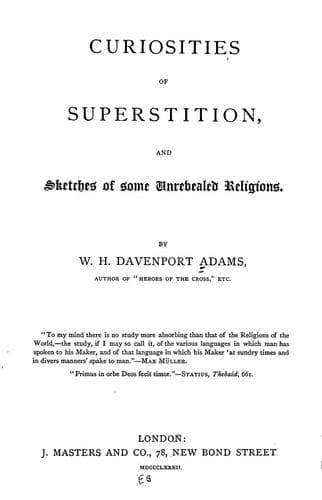
Curiosities of Superstition, and Sketches of Some Unrevealed Religions — John Shaqi
Curiosities of Superstition, and Sketches of Some Unrevealed ReligionsAdams, W. H. Davenport (William Henry Davenport)
Religion
Curiosities of Superstition, and Sketches of Some Unrevealed Religions
Adams, W. H. Davenport (William Henry Davenport)
Folklore; Religions; Superstition
The prayer-mill sometimes contains the Tibetan prayer, or litany, for the
six classes of living creatures, namely, the souls in heaven, the evil
spirits in the air, men, animals, souls in purgatory, and souls in hell;
but, as a rule, the Lama worship begins and ends in the famous inscription
to which we have already alluded--_Aum Mani Padmi Hoong_ (to the jewel in
the lotus.) These mystic words are raised in embossed letters on the
exterior of the cylinder, and are closely written on strips of paper
inside. All the sacred places are covered with them; the face of the rock,
the walls of the temple; just as the Alhambra glitters with its
_azulejos_, its blazoned inscriptions from the Kúran.
This mystic sentence is composed as follows: _Aum_ or _Om_, equivalent to
the Hebrew JAH or JEHOVAH, the most glorious title of the Almighty;
_Mani_, the jewel, one of Buddha’s appellations; _Padmi_, the lotus, in
allusion to his lotus-throne; and _Hoong_, synonymous with _Amen_. The
Buddhists regard this “six-syllabled” charm as a talisman of never-failing
efficacy; but by some of the sects it is more or less varied. For
instance: the Chinese Fo-ists read it as _Aum-mi-to-fuh_, which is also
one of Buddha’s titles; and every devout Fo-ist aims at repeating it at
least three hundred thousand times in the course of his life. Some of
their priests will shut themselves up in the temples for months at a time,
and devote themselves to the dreary task of repetition, hour after hour,
day and night. Sometimes, ten or twelve devotees will voluntarily
sequester themselves, and continue all day to cry aloud in chorus; and at
night they undertake the task successively, one person droning through the
monotonous chant while the others sleep. Thus do they think to be heard
for their much speaking! Similar excesses of formalism, however, are
recorded in the history of mediæval Christianity,--in the biographies of
saints and ascetics who have substituted for a practical Christianity and
the active performance of social duties the dreary vanity of an
unprofitable solitude, spent in the discharge of useless penances.
Public-domain text, read in full here on John Shaqi.
Reviews
Reviews
No reviews yet
Be the first to share your thoughts on this work.
Join the Discussion
Join the discussion
Sign in to leave a comment or review.
Sign InorCreate an account