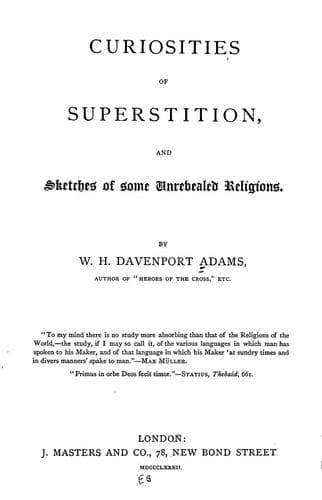
Curiosities of Superstition, and Sketches of Some Unrevealed Religions — John Shaqi
Curiosities of Superstition, and Sketches of Some Unrevealed ReligionsAdams, W. H. Davenport (William Henry Davenport)
Religion
Curiosities of Superstition, and Sketches of Some Unrevealed Religions
Adams, W. H. Davenport (William Henry Davenport)
Folklore; Religions; Superstition
It is to the celebrated Frenchman, Anquetil Duperron, that the scholars of
the West owe their knowledge of these remarkable books. Happening to see a
facsimile of a few pages written in Zend characters, he resolved on
setting out for India in order to purchase manuscripts of all the sacred
books of the Zarathustrian religion, to acquire a thorough insight into
their signification, and to obtain a knowledge of the rites and religious
observances of the Parsees. His means being limited, he entered himself as
a sailor on board a ship of the Dutch Indian Company, and worked his way
out to Bombay in 1754. With money supplied by the French Government to
assist him in his ingenious researches, he bribed one of the most learned
_dustoors_ or priests, Dustoor Darat, or Surat, to procure the treasures
he desired, and to instruct him in the Zend and Pehlvi languages. As soon
as he had acquired the requisite proficiency, he addressed himself to the
task of translating the whole of the Zendavesta into French. This was in
1759. Returning to Europe, he convinced himself of the genuineness of his
purchases by comparing them with MSS. in the Bodleian Library; and, after
several years of arduous labour, produced the first European version in
1771. At the outset, the authenticity of his work was challenged both in
England and Germany; but all doubts have been set at rest by the inquiries
of Rask and others; and thus, through the fanciful enterprise of a young
Frenchman, the veil has been lifted which for so long a period shrouded
the mysterious religion of the Magi.
We do not, however, possess the whole of the Avesta. It is asserted by an
Arabian writer that Zarathustra himself covered with his verses no fewer
than twelve thousand parchments, and who shall compute the extent of the
literature accumulated by his disciples? Whether this literature perished
at the epoch of the Macedonian conquest of Persia, or whether it was
destroyed by Alexander the Great, or whether it gradually perished as the
influence of the Greek philosophy prevailed over the Zarathustrian
theology, it is impossible to determine. The remains of the sacred books,
however, with short summaries of their contents, have been handed down to
us. Originally they were twenty-one in number, called _Nosks_, and each
_Nosk_ consisting of “Avesta” and “Zend”--text and commentary. The number
twenty-one corresponded to the number of words composing the “Honovar,” or
most sacred prayer, of the Zarathustrians. It is, we may add, a magical
number, being the result of the multiplication of the sacred numbers,
_three_ and _seven_.
Public-domain text, read in full here on John Shaqi.
Reviews
Reviews
No reviews yet
Be the first to share your thoughts on this work.
Join the Discussion
Join the discussion
Sign in to leave a comment or review.
Sign InorCreate an account