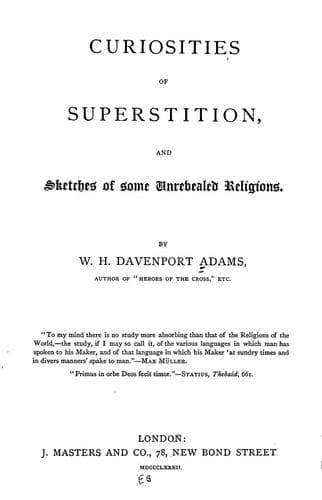
Curiosities of Superstition, and Sketches of Some Unrevealed ReligionsAdams, W. H. Davenport (William Henry Davenport)
Religion
Curiosities of Superstition, and Sketches of Some Unrevealed Religions
Adams, W. H. Davenport (William Henry Davenport)
Folklore; Religions; Superstition
In the first of these we find an account of the creation by Ahura-Mazda,
of sixteen holy regions, sinless spotless Edens, localities of perfect
bliss; each of which is destroyed in succession by Ahriman, the Spirit of
Evil,--a fable evidently suggested by the Mosaic history of Paradise. The
second treats of a certain king, Yimo Vivaugham, who introduced
agriculture into the land of Iran. The third sets forth the various means
by which Zoma, or the Earth, may be rendered happy. You must beware of
excavating deep holes in it, for through these the _devs_, or demons, pass
to and fro between hell and earth; nor must you bury within it the dead
bodies of men or dogs, or other animals. The fourth chapter enumerates six
categories of crime, and the several punishments connected with them. The
fifth and sixth are occupied with a description of various kinds of
impurity. The seventh and eighth contain liturgical directions in
reference to the disposal of the carcases of men and dogs;[19] and it is
stated that whoever eats of flesh so unclean can never be purified, but
that hell will undoubtedly be his portion. Even the house in which a man
or a dog dies must immediately be purified by the use of incense or
sweet-smelling odours; a sanitary precaution of some importance in hot
climates. In the ninth occurs an elaborate detail of the rite of
purification denominated the _Barathium_, to be performed by, and on
behalf of a person who shall have been unwittingly defiled by touching the
dead. The tenth and eleventh are not less minute in their directions what
word must be repeated twice, and thrice, and four times at the different
Gâthas, in order that Ahriman and his lieutenants may be expelled from men
and women who have been in contact with the dead, and from houses, cities,
and provinces into which they have obtained an entrance.
Public-domain text, read in full here on John Shaqi.
Reviews
Reviews
No reviews yet
Be the first to share your thoughts on this work.
Join the Discussion
Join the discussion
Sign in to leave a comment or review.
Sign InorCreate an account