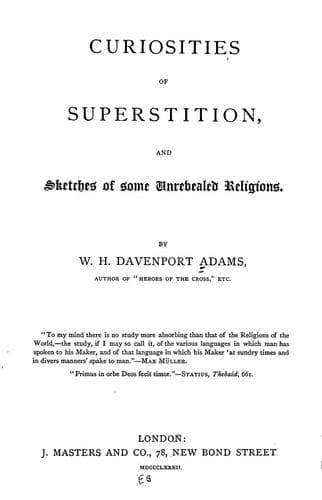
Curiosities of Superstition, and Sketches of Some Unrevealed Religions — John Shaqi
Curiosities of Superstition, and Sketches of Some Unrevealed ReligionsAdams, W. H. Davenport (William Henry Davenport)
Religion
Curiosities of Superstition, and Sketches of Some Unrevealed Religions
Adams, W. H. Davenport (William Henry Davenport)
Folklore; Religions; Superstition
The twelfth Fargard treats of various funeral ceremonies, and repeats a
number of injunctions relative to the cleansing of places, of clothes and
other articles, polluted by lifeless bodies. It concludes with elaborate
warnings against a two-footed _dev_, called Ashmog. The thirteenth and
fourteenth run riot in praise of the noble qualities of dogs, and severe
in their rebuke of the “superior animals” who ill-use them. The fifteenth
reads like a Commination Service, in its denunciation of certain crimes
which can never be undone even by the profoundest penitential offices, and
are punished by Ahura-Mazda with eternal condemnation. The seventeenth,
like the sixteenth, is tediously liturgical, and discusses such minutiæ as
the arrangement of the hair of the head, the extraction of bad or gray
hairs, and the cutting of nails. If these operations are performed
without certain prescribed ceremonies, the devs come upon earth, and
parasitical organisms are produced to the great discomfort and injury of
man. The eighteenth lays down the distinctions which should characterise
an _Athrava_, or priest. He must wear the _padan_, a mouth-cover, of two
fingers’ breadth; must carry an instrument for disposing of parasitical
insects; devote his nights to study, keep alive the sacred fire, and
succour the distressed. The nineteenth chapter recounts the perils to
which Zarathustra was exposed, when he had left the south on his mission,
from the murderous assaults of Ahriman and his host, who hastened up from
the north; the north, to an inhabitant of the warm sunny south, naturally
appearing the fit home and haunt of the Spirit of Evil. The twentieth is
devoted to the praise of Taneslied, who is represented as having swept
away disease, death, bloodshed, war, evil-doers, falsehood, and all kinds
of wickedness. The twenty-first enjoins the salutations to be paid to the
sacred Bull, and extols some of its illustrious qualities. Finally, the
twenty-second narrates the mission of Zarathustra, and describes the evil
he will dispel through the influence of the Word; Ahura-Mazda having
ordered him to establish his worship in the region called Airya-Mava, or
Irman, so that it may become bright, pure, and happy as the abode of
Ahura-Mazda himself, free from sin, and, consequently, free from sorrow
and suffering.
Public-domain text, read in full here on John Shaqi.
Reviews
Reviews
No reviews yet
Be the first to share your thoughts on this work.
Join the Discussion
Join the discussion
Sign in to leave a comment or review.
Sign InorCreate an account