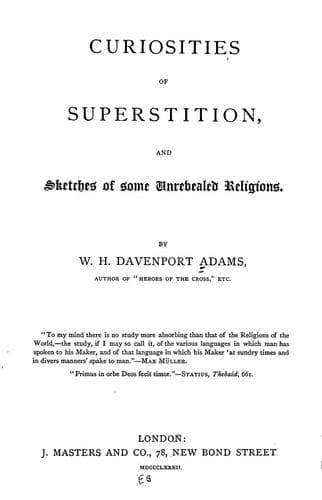
Curiosities of Superstition, and Sketches of Some Unrevealed Religions — John Shaqi
Curiosities of Superstition, and Sketches of Some Unrevealed ReligionsAdams, W. H. Davenport (William Henry Davenport)
Religion
Curiosities of Superstition, and Sketches of Some Unrevealed Religions
Adams, W. H. Davenport (William Henry Davenport)
Folklore; Religions; Superstition
The Buddhist prayer which is consecrated to Buddha as the Chakravarta
Rajah, or King of the Wheel, proves, on examination, to be closely related
to that Sun-worship which prevailed in the early ages of the world. The
wheel is, in many creeds, the symbol of the sun’s chariot, that is, of the
revolution of the heavenly bodies. In a sculpture, nearly two thousand
years old, on the Bilsah Tepe, Buddha is represented simply by a wheel,
overshadowed by the mystic _chattah_, or golden umbrella, which is a
common emblem of his power. His worshippers are represented as making
their offerings to the King of the Wheel. “This sacred Wheel of the Law,
or Wheel of Faith, is found again and again among the fain and Buddhist
sculptures in the caves of Ellora and Ajunta, in most cases projecting in
front of Buddha’s Lotus-Throne. In one instance an astronomical table is
carved above the wheel. In another it is supported on either side by a
stag, supposed to represent the fleetness wherewith the sun runs his daily
circuit, ‘going forth from the uttermost part of the heaven, and running
about unto the end of it again.’”
THE HINDU TEMPLES.
Visiting the Temples at Hardwar, one of the sacred cities of India, Miss
Gordon Cumming remarks upon the number of their hideous idols, painted and
carved, their multitudinous brass bells, their brazen horns, their sacred
courts all covered with elaborate carving, and their mythological
sculptures.
She says:--“I frankly confess that there is something startling in the
rapidity with which one gets quite at home amongst all this paraphernalia
of heathenism, and how very soon idolatry ceases to shock the mind, and
becomes merely a curious study with picturesque adjuncts. Six months
previously the sight of a veritable temple with its hideous idols and
devout worshippers was a thing from which one shrank in shuddering pity.”
But she soon became a connoisseur, and “lounged from one temple to
another, inspecting jewels and exquisite stone carving, and anything
wonderful the priests had to show, and quite forgot to be shocked, it was
all so perfectly natural, and seemed so entirely in keeping with the
tastes of the people.” In this remark there is a wonderful _naïveté_; for
it may reasonably be supposed that the tastes of the people would be in
accord with a religion which, during its career of two thousand years,
must have exercised so great an influence in forming them!
In some of the temples, according to the same writer, there are sacred
bulls, carved in white marble and adorned with costly necklaces. In others
the attendant priests spend the whole day in pouring single drops of
precious oil on holy pebbles brought from the Nerbudda and other sacred
streams, and here arranged in little trays. Amongst the privileged
inhabitants are the monkeys, who frolic about incessantly with their
babies in their arms, or sitting on their backs, and twining their little
arms round the parental necks.
Public-domain text, read in full here on John Shaqi.
Reviews
Reviews
No reviews yet
Be the first to share your thoughts on this work.
Join the Discussion
Join the discussion
Sign in to leave a comment or review.
Sign InorCreate an account