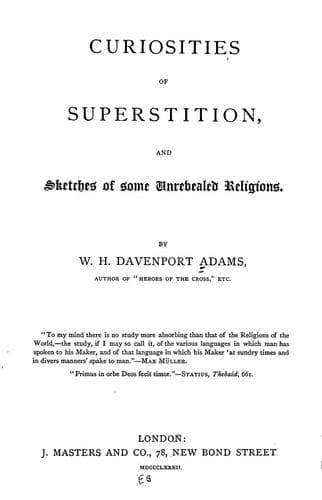
Curiosities of Superstition, and Sketches of Some Unrevealed ReligionsAdams, W. H. Davenport (William Henry Davenport)
Religion
Curiosities of Superstition, and Sketches of Some Unrevealed Religions
Adams, W. H. Davenport (William Henry Davenport)
Folklore; Religions; Superstition
A number of playful young kids were next brought forward. The priest
sprinkled them with water. On the ground lay a large flat brazen dish, and
one of the villagers stood beside it with a sacred hatchet, rudely
ornamented. At a single blow he struck off the head of a kid. The priest’s
assistant raised the head, and muttering certain words, presented it to
the Khuda. Dipping his finger into the blood, he flicked some drops upon
the carven image, and placed the head with the other offerings. Meanwhile,
the kid’s body had been so disposed that all its blood dripped into the
brazen vessel; and when two or three animals had been sacrificed and the
dish was full, one of the men lifted it up, and, first presenting it to
the Khuda, turned round, and swang the body against the whitewashed wall
of the temple, so as to empty it of blood. This ceremony was thrice
repeated.
The festival is known as the _Akrot-ka-pooja_, or Walnut Festival, from
the pastime that follows the sacrificial scene. The priest, with a few
companions, takes his place in the balcony of the temple, and all the
young men present pelt them liberally with walnuts and green pine-cones,
which the group in the balcony rapidly collect and return in plentiful
volleys. For about half-an-hour this severe encounter lasts, when the
assailed descend, and once more mingle with the crowd.
By this time the sacrificial kids have been cooked, and the people seating
themselves on the paved space in front of the Khuda, cakes and flesh are
served out among them. In opposition to the usual Eastern custom, the
women are helped before the men. It is now time for the homeward journey,
but the mysterious oscillation of the Khuda is understood to signify its
desire to visit the neighbouring village of Cheenee; and thither the
multitude at once proceed, dancing, singing, shouting, while the forest
glades resound with the trumpets and the tomtoms, and a few of the
nimbler-footed speed ahead to give notice to the authorities at Cheenee of
the honour in store for them. When near the latter village, the procession
is met by the goddess of Cheenee, with her retinue, and an exchange of
courtesies takes place. Next morning, the goddess of Kothi, or Coatee,
returns to her own charge.
SHAMANISM: DEVIL-DANCING.
In many parts of Central and Southern India the rite of Devil-Dancing is
practised, and Bishop Caldwell gives a striking description of it as it
exists among the Shawars of Tinnevelly:[24]
Public-domain text, read in full here on John Shaqi.
Reviews
Reviews
No reviews yet
Be the first to share your thoughts on this work.
Elsewhere in the archive
Join the Discussion
Join the discussion
Sign in to leave a comment or review.
Sign InorCreate an account