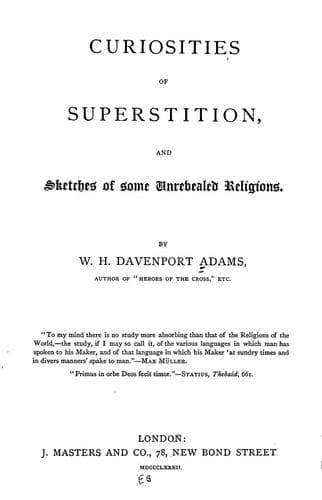
Curiosities of Superstition, and Sketches of Some Unrevealed ReligionsAdams, W. H. Davenport (William Henry Davenport)
Religion
Curiosities of Superstition, and Sketches of Some Unrevealed Religions
Adams, W. H. Davenport (William Henry Davenport)
Folklore; Religions; Superstition
“When the preparations are completed and the devil-dance is about to
commence, the music is at first comparatively slow; the dancer seems
impassive and sullen, and he either stands still or moves about in gloomy
silence. Gradually, as the music becomes quicker and louder, his
excitement begins to rise. Sometimes, to help him to work himself up into
a frenzy, he uses medicated draughts, cuts and lacerates himself till the
blood flows, lashes himself with a huge whip, presses a burning torch to
his breast, drinks the blood which flows from his own wounds, or drains
the blood of the sacrifice, putting the throat of the decapitated goat to
his mouth. Then, as if he had acquired new life, he begins to brandish his
staff of bells, and to dance with a quick but wild unsteady step.
Suddenly the afflatus descends; there is no mistaking that glare, or those
frantic leaps. He snorts, he swears, he gyrates. The demon has now taken
bodily possession of him, and though he retains the power of utterance and
motion, both are under the demon’s control, and his separate consciousness
is in abeyance. The bystanders signalize the event by raising a long
shout, attended with a peculiar vibratory noise, caused by the motion of
the hand and tongue, or the tongue alone. The devil-dancer is now
worshipped as a present deity, and every bystander consults him respecting
his diseases, his wants, the welfare of his absent relatives, the
offerings to be made for the accomplishment of his wishes, and, in short,
everything for which superhuman knowledge is supposed to be available.”
* * * * *
Before we quit this subject, it may be for the interest and convenience of
the reader, if we offer a brief account of the doctrines and rites of
Brahmism. This movement against the old Hindu faith, initiated by Rammohun
Roy, and developed by Babu Keshub Chunda Sen, owes its origin, however
unconsciously, to the influence of Christianity, which the Hindu mind, on
awaking from its long sleep of centuries, found, as it were, by its side,
and the pure and elevated character of which it could not but recognise.
Public-domain text, read in full here on John Shaqi.
Reviews
Reviews
No reviews yet
Be the first to share your thoughts on this work.
Elsewhere in the archive
Join the Discussion
Join the discussion
Sign in to leave a comment or review.
Sign InorCreate an account