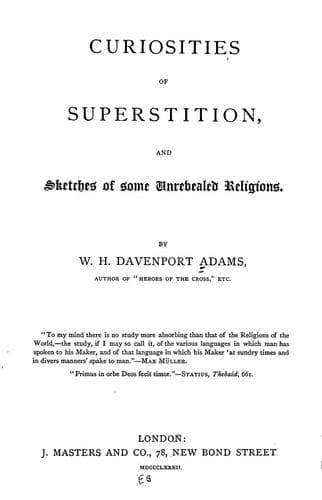
Curiosities of Superstition, and Sketches of Some Unrevealed ReligionsAdams, W. H. Davenport (William Henry Davenport)
Religion
Curiosities of Superstition, and Sketches of Some Unrevealed Religions
Adams, W. H. Davenport (William Henry Davenport)
Folklore; Religions; Superstition
Rammohun Roy was born in the district of Moorshadabad in 1772, and was
upwards of forty years of age when he undertook the part of a religious
reformer. A man of considerable natural powers, he had cultivated them
carefully, acquired a thorough knowledge of Sanskrit and Arabic, and
accompanied his meditations on the Sastras, or Hindu religious books, with
a close study of the English Scriptures. Removing to Calcutta in 1814, he
endeavoured to engage his friends in the same pursuits, and as this effort
led him naturally to new inquiries, he soon came to abandon his belief in
traditional Hinduism. A cry of ‘infidel!’ was immediately raised against
him; he became the subject of an incessant hostility; was on one occasion
mobbed in the streets of Calcutta; and owed his life to the protection of
the British Government. Persecution, however, could not quench his thirst
after knowledge. He applied himself to the study of Greek and Hebrew,
that by reading the Bible in its original languages, he might penetrate
more thoroughly into the spirit of Hebrew and Christian devotion.
Having dismissed the authority of the Puranas, he rested his faith on the
Vedas, the oldest of the Hindu sacred books, in the conviction (an
erroneous one) that the old creed of Hinduism was monotheistic, and the
belief (a justifiable one) that the Puranas represented the degeneracy of
a later age. Strange to say, he did not detect the Pantheism that
overflows the Vedas: in the Upanishads or treatises attached to them, he
fancied that he saw a pure Deism, and to diffuse this among his
countrymen, he published numerous translations and organised a society of
believers, who recited texts from the Vedas, and chanted Christian hymns.
In 1830 he went further; founding a prayer-meeting, which proved the seed
of what is now known as the Brahma Samáj. The building erected for the
purpose of holding the meetings was, according to the trust deed, to be
open to people of all sorts and conditions, “who shall behave and conduct
themselves in an orderly, sober, religious, and devout manner, for the
worship and adoration of the Eternal, Unsearchable, and Immutable Being,
who is the Author and Preserver of the Universe, but not under and by any
other name, designation, or title, peculiarly used for and applied to any
particular Being or Beings by any man or set of men whatsoever.” It
provided also, in direct opposition to the practices of Hinduism, that no
graven image, sculpture, carving, picture, painting, portrait, or likeness
of anything, should “be admitted within the walls of this building;” that
no animal sacrifices should take place there; that no eating or drinking,
feasting or rioting, should be permitted; that evil speaking against the
beliefs of men should be prohibited; and that no prayer, or sermon, or
teaching should be allowed, unless it had “a tendency to the contemplation
of the Author and Preserver of the Universe, or to the promotion of
Public-domain text, read in full here on John Shaqi.
Reviews
Reviews
No reviews yet
Be the first to share your thoughts on this work.
Elsewhere in the archive
Join the Discussion
Join the discussion
Sign in to leave a comment or review.
Sign InorCreate an account