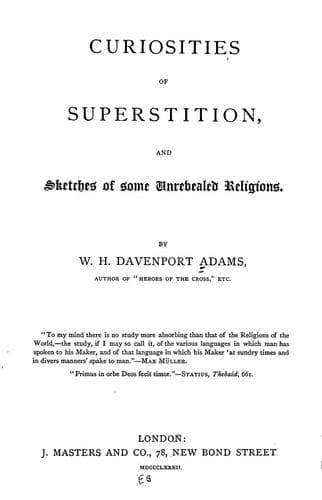
Curiosities of Superstition, and Sketches of Some Unrevealed Religions — John Shaqi
Curiosities of Superstition, and Sketches of Some Unrevealed ReligionsAdams, W. H. Davenport (William Henry Davenport)
Religion
Curiosities of Superstition, and Sketches of Some Unrevealed Religions
Adams, W. H. Davenport (William Henry Davenport)
Folklore; Religions; Superstition
Not the least remarkable objects in the Hindu temples are their great
statues of bulls in marble or in metal. It is worthy of note that “in the
great Brazen Laver, which Solomon was commanded to make for the use of the
Temple at Jerusalem, the symbols selected for the adornment of that
consecrated Molten Sea should have been those which in later ages were to
hold so prominent a place in the symbolism of faiths so widely spread as
those of Brahma and Buddha. That huge laver was supported by twelve oxen
of cast metal, three looking to each point of the compass, while the brim
of the great sea itself was all wrought with flowers of lilies, much the
same as the pattern of lotus or water-lily with which the shrine of Buddha
is invariably edged.” The bull is another symbol which seems to connect
the creed of the Hindu with the old nature-worship; for the vernal equinox
takes place when the sun enters the sign of Taurus, and this event was
always and everywhere a signal for feasting and rejoicing.
But, as Max Müller observes, the ancient religion of the Aryan inhabitants
of India started, like the religion of Greece and Rome, of the Germans,
Slavs, and Celts, with a simple and intelligible mythological
phraseology.[2] In the Veda, the names of all the so-called gods or Devas
undisguisedly betray their original physical character and meaning. Under
the name of Agni (ignis) was praised and invoked the fire; the earth by
that of Prithvî (the brave); the sky by the name of Dyu (Zeus, Jupiter),
and afterwards of Indra; the firmament and the waters by the name of
Οὐρανός. Under many appellations was the sun invoked, such as Sûrya,
Savitri, Vishnu, or Mitra; and the dawn by the titles of Ushas, Urvasî,
Ahanâ, and Sûrya. Nor was the moon forgotten: for though not often
mentioned under its usual name of Kandra, reference is made to it under
its more sacred appellation of Soma; and a particular denomination was
reserved for each of its phases. There is hardly any fact of nature, if it
could impress the human mind in any way with the ideas of a higher power,
of order, eternity, or beneficence,--whether the woods, or the rivers, or
the trees, or the mountains,--without a name and representative in the
early Hindu Pantheon. No doubt there existed in the human mind, from the
very beginning, something, whether we call it a suspicion, an innate idea,
an intuition, or a sense of the Divine. What distinguishes man from the
rest of the animal creation is chiefly his ineradicable feeling of
dependence and reliance upon some higher power; that consciousness of
bondage, from which the very name of “religion” was derived. “It is He
that hath made us, and not we ourselves.” The presence of that power was
felt everywhere, and nowhere more clearly and strongly than in the rising
and setting of the sun, in the change of day and night, of spring and
winter, of birth and death. But although the Divine Presence was felt
Public-domain text, read in full here on John Shaqi.
Reviews
Reviews
No reviews yet
Be the first to share your thoughts on this work.
Join the Discussion
Join the discussion
Sign in to leave a comment or review.
Sign InorCreate an account