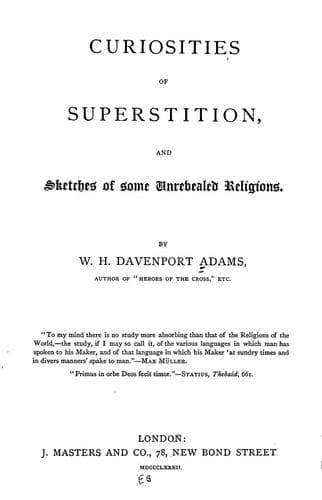
Curiosities of Superstition, and Sketches of Some Unrevealed ReligionsAdams, W. H. Davenport (William Henry Davenport)
Religion
Curiosities of Superstition, and Sketches of Some Unrevealed Religions
Adams, W. H. Davenport (William Henry Davenport)
Folklore; Religions; Superstition
everywhere, it was impossible, in that early period of thought, and with a
language incapable as yet of defining anything but material objects, to
conceive the idea of God in its purity and fulness, or to assign to it an
adequate and worthy expression.
It must also be remembered that the influence of the genius and forces of
Nature would necessarily be greater in an age when the human mind was
occupied by few objects of thought, than now when it ranges over the whole
world of art and science. Moreover, to the eye of ignorance everything
seems large and portentous, or dim and inscrutable. The fire from heaven,
the reverberating thunder, the gale that crashed down the mountain ravines
and felled great trees before it, the planetary bodies steadily revolving
in their courses, the stream with its glow and its ripple, the dense
shadows of the haunted forest, the recurring rush and roll of the
sea,--all these were things which for early man had a constant novelty and
strangeness, and seemed incessantly to claim his reverent consideration.
He could not account for them: whether a bane or a delight they were
equally unintelligible. They represented, therefore, some Power which he
could regard only with awe and reverence. And of that Power the sun would
necessarily be the chief type and symbol. All life and love seemed
dependent upon it. The trees throve, and the flowers bloomed, and the
banks rippled, and the birds sang, and the harvests ripened, through the
sun. It was the source of light and heat, of the vigour and activity of
nature. While it shone men’s hearts leaped with joy, and the wheels of
labour revolved with pleasant toil; but when it disappeared, and the
darkness usurped the heavens, the spirits sank, and humanity felt in the
change of scene a presentiment and presage of the darkness of death. All
vitality, all motion centred in the sun. “It was like a deep furrow,” says
Max Müller, “which that heavenly luminary drew, in its silent procession
from east to west, over the fallow mind of the gazing multitude; and in
the impression left there by the first rising and setting of the sun,
there lay the dark seed of a faith in a more than human being, the first
intimation of a life without beginning, of a world without end.” Who can
wonder that the Chaldean, and the Celt, alike ascended to the high places,
and paid their worship of symbolic fires to the great fountain of life and
light, the central force of the universe? Who can wonder that all the
Aryan tribes made it, so to speak, the nucleus of their religious systems?
The Hindu peasant, centuries ago, addressed it in his heart in much the
same language which Gawain Douglas afterwards employed. As its glorious
orb rose above the gleaming horizon, he sent forth to it a message of
welcome:
Public-domain text, read in full here on John Shaqi.
Reviews
Reviews
No reviews yet
Be the first to share your thoughts on this work.
Join the Discussion
Join the discussion
Sign in to leave a comment or review.
Sign InorCreate an account