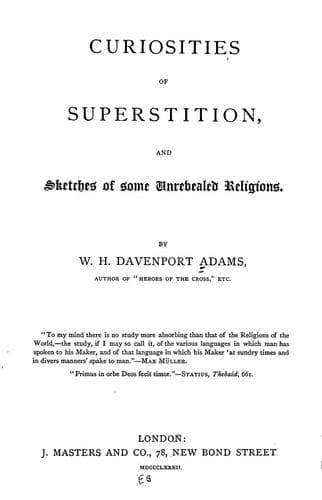
Curiosities of Superstition, and Sketches of Some Unrevealed ReligionsAdams, W. H. Davenport (William Henry Davenport)
Religion
Curiosities of Superstition, and Sketches of Some Unrevealed Religions
Adams, W. H. Davenport (William Henry Davenport)
Folklore; Religions; Superstition
charity, morality, piety, benevolence, virtue, and the strengthening of
the bonds of union between men of all religious persuasions and creeds.”
Here we have a distinct advance on Brahmanism and even on Buddhism, but
the religious system indicated in the closing sentence is nevertheless as
vague as it is cold; and lacks that vital element which Christianity
derives from its recognition of GOD the FATHER and CHRIST the SAVIOUR.
However, Rammohun Roy, in his fashion, was a sincere “seeker after GOD;”
and in his vague endeavour to grasp the truth he persevered in the face of
an intolerant opposition. He still continued to give a foremost place to
the Vedas as channels of religious instruction, but he introduced the
Psalms of David; and as time wore on, he separated himself more and more
completely from the traditions of orthodox Hinduism. Even his faith in the
Vedas came to be much shaken; and finding himself at last in that state of
isolation which is the suffering and martyrdom of the man in advance of
his age, he quitted India and went to live in England. At Bristol he
resided, much esteemed, until his death in 1833.
For awhile the torch which he had lighted flickered ominously near to
extinction, until, in 1841, it passed into the hands of Babu Debendronath
Tagore. By him it was again lighted up; and as much had happened since
Rammohun Roy’s departure, as education had gradually weakened the old
traditional prejudices, it became the rallying-point of a crowd of earnest
inquirers. Debendronath Tagore devoted himself with eager unselfishness,
giving unsparingly of his time, his money, and his talents. His work
derived no inconsiderable moral support from his unblemished personal
character. He provided the Samáj with a printing-press, expended much
money in fitting up their place of worship, and collected a valuable
library of the Hindu sacred books, besides providing for the support of
poor but promising students, sent to Benares to prosecute their studies.
A remarkable change, however, soon came over the faith and teaching of the
Samáj. Hitherto, as we have seen, they had been based upon the Vedas, as
the authorized rule of Hindu theology; but inquiry and criticism had
gradually disclosed their Pantheistic character, and their consequent
incompatibility with the creed of the Samáj. Thus it came to pass that
about 1850 the Vedas had to go; and the members of the Samáj no longer
called themselves Vedantists but Brahmoists, or Brahmists (from _Brahm_,
or Brahma, the Supreme Being.) In other words, they openly became
Theists.
Public-domain text, read in full here on John Shaqi.
Reviews
Reviews
No reviews yet
Be the first to share your thoughts on this work.
Elsewhere in the archive
Join the Discussion
Join the discussion
Sign in to leave a comment or review.
Sign InorCreate an account