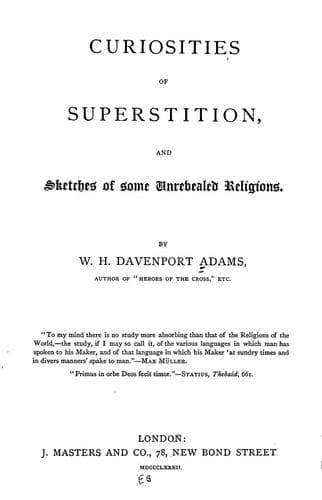
Curiosities of Superstition, and Sketches of Some Unrevealed ReligionsAdams, W. H. Davenport (William Henry Davenport)
Religion
Curiosities of Superstition, and Sketches of Some Unrevealed Religions
Adams, W. H. Davenport (William Henry Davenport)
Folklore; Religions; Superstition
A religious sect, brought together by a common monotheism and accepting a
common covenant, was naturally impelled towards an expansion of their
creed. But this expansion in the case of the Brahma Samáj, was probably
hastened by the number of branch Samájes that sprang up in the
neighbourhood of the metropolis and in some of the larger towns of the
Bengal presidency. These branches, constantly increasing in number through
the accessions of educated young men from the colleges and zillah schools,
naturally looked to the parent Samáj to define and establish their creed;
and what must be regarded as an authoritative exposition of it was
published in 1868. The following is a summary of it:--
“1. The book of Nature and Intuition form the basis of the Brahmaic faith.
“2. Although the Brahmas do not consider any book written by man the basis
of their religion, yet do they accept with pleasure and respect any
_truth_ contained in any book.
“3. The Brahmas believe that the religious condition of man is
progressive, like the other facts of his condition in this world.
“4. They believe that the fundamental doctrines of their religion are at
the basis of every religion followed by man.
“5. They believe in the existence of One Supreme GOD--a GOD endowed with a
distinct personality, and attributes equal to His nature, and intelligence
befitting the Governor of the Universe; and worship Him--Him alone. They
do not believe in His incarnation.
“6. They believe in the immortality and progressive state of the soul, and
declare that there is a state of conscious existence succeeding life in
this world, and supplementary to it as respects the action of the
universal moral government.
“7. They believe that atonement is the only way to salvation. They do not
recognise any other mode of reconcilement to the offended but loving
Father.
“8. They pray for _spiritual_ welfare, and believe in the _efficacy_ of
real prayers.
“9. They believe in the Providential care of the Divine Father.
“10. They avow that love towards Him, and performing the works He loveth,
constitute His worship.
“11. They recognise the necessity of public worship, but do not believe
that they cannot hold communion with the Great Father without resorting to
any fixed place at any fixed time. They maintain that we can adore Him at
any time and at any place, provided that time and that place are
calculated to compose and direct the mind towards Him.
“12. They do not believe in pilgrimages, but declare that holiness can be
attained only by elevating and purifying the mind.
Public-domain text, read in full here on John Shaqi.
Reviews
Reviews
No reviews yet
Be the first to share your thoughts on this work.
Elsewhere in the archive
Join the Discussion
Join the discussion
Sign in to leave a comment or review.
Sign InorCreate an account