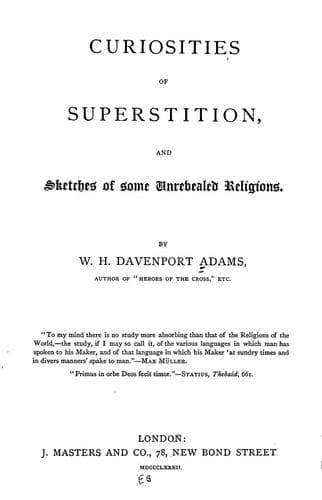
Curiosities of Superstition, and Sketches of Some Unrevealed ReligionsAdams, W. H. Davenport (William Henry Davenport)
Religion
Curiosities of Superstition, and Sketches of Some Unrevealed Religions
Adams, W. H. Davenport (William Henry Davenport)
Folklore; Religions; Superstition
“13. They do not perform any rites and ceremonies, or believe in penances,
as instrumental in obtaining the grace of GOD. They declare that moral
righteousness, the gaining of wisdom, Divine contemplation, charity, and
the cultivation of devotional feelings, are their rites and ceremonies.
They further say, Govern and regulate your feelings, discharge your duties
to GOD and to man, and you will gain everlasting blessedness; purify your
hearts, cultivate devotional feelings, and you will see Him who is Unseen.
“14. Theoretically, there is no distinction of caste among the Brahmas.
They declare that we are all the children of GOD, and, therefore, must
consider ourselves as brothers and sisters.”
Briefly speaking, the religious system herein set forth may be described
as Christianity without CHRIST; and yet it was unwilling to acknowledge
its obligations to Christianity. Its apostles sought to persuade
themselves and others that they derived everything from the Vedas and
nothing from the Bible; and when they were compelled to abandon the Vedas,
they fell back upon Nature as a Divine Revelation. But, as an Anglo-Indian
authority contends, it is certain that but for the new life which at this
time flowed in with the tide of Western thought, and the study of a
literature “saturated at every pore” with Christian sentiment and the high
Gospel morality; and but for the strong and ceaseless opposition
maintained by Christianity in the person of its missionaries against the
Atheism, which was the first, though a short-lived result of the sudden
intellectual quickening the young men of Calcutta experienced when Western
science was substituted for Oriental myths, neither would the study of the
Vedas have been revived, nor would the great lessons of nature have
appeared so intelligible as they then became.[25]
We have seen that Brahmanism made one advance under Rammohun Roy; it was
led still further forward by Debendronath Tagore; and then he too suddenly
halted, as his predecessor had done. The leadership next devolved upon a
man of higher courage, not less fitted to lead a great movement by his
enthusiasm than by his ability, Babu Keshub Chunda Sen. Keshub was
determined that the challenge should be thrown down to orthodox Hinduism:
and persuaded Debendronath Tagore, when his daughter was married, to
celebrate the occasion without the usual idolatrous ceremony. After this,
he purified of their idolatrous element the rites observed at birth and
death. Still, Debendronath Tagore supported him; but, at last, when an
attempt was made to eliminate not only what was purely idolatrous, but
also everything offensive to enlightened feeling and a purer taste,
Debendronath and the conservative party opposed, and a schism was the
result.
Public-domain text, read in full here on John Shaqi.
Reviews
Reviews
No reviews yet
Be the first to share your thoughts on this work.
Elsewhere in the archive
Join the Discussion
Join the discussion
Sign in to leave a comment or review.
Sign InorCreate an account