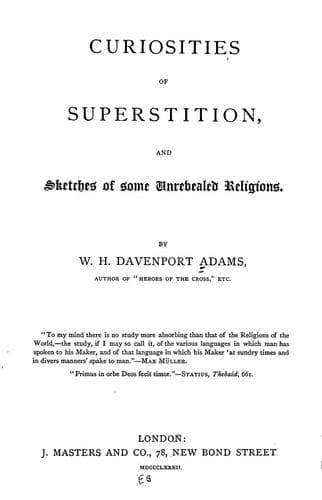
Curiosities of Superstition, and Sketches of Some Unrevealed ReligionsAdams, W. H. Davenport (William Henry Davenport)
Religion
Curiosities of Superstition, and Sketches of Some Unrevealed Religions
Adams, W. H. Davenport (William Henry Davenport)
Folklore; Religions; Superstition
“The time had arrived,” says the writer already quoted, “when Brahmism, if
it was a power and not mere talk, must do battle with the system of caste
distinctions. The first step in this direction taken by Keshub Chunda Sen,
was the celebration of a marriage between persons belonging to different
castes. That was an innovation such as might well startle the venerable
pundits of Nuddea and Benares. There could henceforward be no doubt as to
the more than heretical tendency of the theistic doctrine. An electric
shock ran through society: all Hindudom was roused from its slumber, and
began suspiciously to ponder what Brahmism meant by such daring. But the
real test of principle was yet to come. It was comparatively safe to make
a few modifications in domestic religious rites: the marriage of people of
different castes compromised the principals chiefly: it was necessary that
the entire Brahma community should by some act be universally committed to
war against the evils and iniquities of caste. Keshub and his party
accepted this necessity, threw off the sacred thread that distinguished
them as Brahmans, and insisted that all who desired membership with their
Samáj should consent to renounce caste. There could be no greater triumph
than this, of principle over traditionalism: it stamped Brahmism as a
power in the land, and not an idle theological speculation.”
Thenceforward, Keshub Chunda Sen became the recognised leader of “the
Brahma Samáj of India,” and the new sect adopted an active proselytism.
Branch Samájes have been established all over the country; missionaries
have been sent as far as Madras and Bombay and the Punjab. Tracts and
lectures have been freely circulated. In Calcutta a so-called “church” has
been built, and is well attended every Sunday evening, not only by men,
but by women, for whom special accommodation is provided. The services are
conducted in the vernacular, so as to be intelligible to all worshippers.
Brahmist hymns are sung to the accompaniment of the harmonium, and the
solemn _mridong_ (a kind of drum): passages are read from a book of
selections in which the extracts from the Bible greatly outnumber those
from any other source; extemporaneous prayers are offered with an
intensity of spiritual feeling that could do no disgrace to a Christian
congregation; and discourses are delivered which breathe a pure and noble
tone of sentiment and feeling. Two weekly periodicals, one Bengali and the
other English, the “Dharma Tattwa” and the “Indian Mirror,” are the
recognised exponents of the views and teaching of the Samáj.
CHAPTER V.
_THE HINDU MYTHOLOGY: AND THE VISHNU PURANA._
Public-domain text, read in full here on John Shaqi.
Reviews
Reviews
No reviews yet
Be the first to share your thoughts on this work.
Elsewhere in the archive
Join the Discussion
Join the discussion
Sign in to leave a comment or review.
Sign InorCreate an account