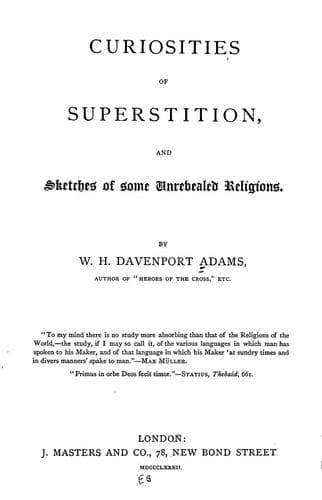
Curiosities of Superstition, and Sketches of Some Unrevealed ReligionsAdams, W. H. Davenport (William Henry Davenport)
Religion
Curiosities of Superstition, and Sketches of Some Unrevealed Religions
Adams, W. H. Davenport (William Henry Davenport)
Folklore; Religions; Superstition
The word _Purana_ means “old,” and the original object of the Puranas
would seem to have been the preservation of ancient mythological fictions
and historical traditions. But in the form in which they have come down to
us they do something more than this. They comprehend, more or less
thoroughly, the five following subjects:--1, Primary creation, or
cosmogony; 2, Secondary creation, or the destruction and renovation of
worlds, including chronology; 3, Genealogy of gods and patriarchs; 4,
Reigns of the Manus, or periods called Manwantaras; and 5, History, or
such particulars as are extant of the princes of the solar and lunar
races, and of their descendants to modern times. According to Professor
Wilson, they are evidently derived from the same religious system as the
Rámáyana and Mahábhárata, or from what he calls the mytho-heroic stage of
Hindu belief. “They present, however, peculiarities which designate their
belonging to a later period, and to an important modification in the
progress of opinion. They repeat the theoretical cosmogony of the two
great poems; they expound and systematise the chronological computations;
and they give a more definite and connected representation of the
mythological fictions and the historical traditions. But besides these and
other particulars, which may be derivable from an old, if not from a
primitive era, they offer characteristic peculiarities of a more modern
description, in the paramount importance which they assign to individual
divinities, in the variety and purport of the rites and observances
addressed to them, and in the invention of new legends illustrative of the
power and graciousness of those deities, and of the efficacy of implicit
devotion to them.”
The form of composition adopted in the Puranas is that of a dialogue, in
which its contents are related by one imaginary individual in reply to
another. Several dialogues are eventually woven together; and they purport
to have been held on different occasions between different individuals, in
consequence of similar questions having been asked. Usually the immediate
narrator is Lomaharshaná or Romaharshána, the disciple of Vyasa, who, as
Plato did for Socrates, communicates to the reader his great master’s
utterances. The Vyasa or compiler here meant was Krishna Dwaipáyana, the
son of Parásara; it is said of him that he taught the Vedas and Puranas to
various pupils, but it seems more probable that he was at the head of a
school or college, the members of which moulded the sacred literature of
the Hindus into its present form.
There appear to have been eighteen Puranas: namely, 1, Brahma; 2, Padma;
3, Vaishnava; 4, Saiva; 5, Bhagavata; 6, Náradíya; 7, Márkándeya; 8,
Agneya; 9, Bhavishya; 10, Brahma Vaivarta; 11, Lainga; 12, Váráha; 13,
Skánda; 14, Vámana; 15, Kaurma; 16, Mátsya; 17, Gáruda; 18, Bráhmanda.
Public-domain text, read in full here on John Shaqi.
Reviews
Reviews
No reviews yet
Be the first to share your thoughts on this work.
Elsewhere in the archive
Join the Discussion
Join the discussion
Sign in to leave a comment or review.
Sign InorCreate an account