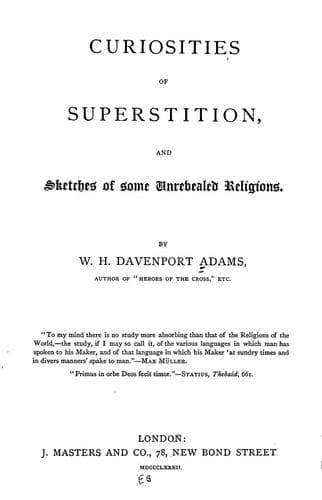
Curiosities of Superstition, and Sketches of Some Unrevealed ReligionsAdams, W. H. Davenport (William Henry Davenport)
Religion
Curiosities of Superstition, and Sketches of Some Unrevealed Religions
Adams, W. H. Davenport (William Henry Davenport)
Folklore; Religions; Superstition
The Vishnu Purana is described as that in which Parásara, beginning with
the events of the Varáha Kalpa, expounds man’s moral and religious
obligations in about seven thousand stanzas. It is divided into six
books:--
The first deals chiefly with the details of creation, primary (Sarga) and
secondary (Pratisarga); the first explaining how the universe proceeds
from Prakriti or eternal crude matter; the second, in what way “the forms
of things are developed from the elementary substances previously evolved,
or how they reappear after their temporary destruction.” Both these
creations are periodical; the first does not end until the life of Brahma
ends, when not only the gods and all other forms are annihilated, but the
elements are resolved into the primary substance, besides which one only
spiritual being exists. The latter occurs at the end of every Kalpa, æon,
or day of Brahma, and is wholly limited to the forms of inferior creatures
and the lower worlds; leaving untouched sages and gods and the substance
of the heavens. A description of the ages or periods of time on which
these events depend is involved in the explanation; and it is given
accordingly in wearisome detail. Their character has been a source of very
unnecessary perplexity to European writers; for they belong to a wholly
mythological scheme of chronology, which has no reference to any real or
supposed history of the Hindus, but prefigures, according to their system,
the infinite and eternal revolutions of the universe.
By a singular incongruity the existence of Pradhána, or crude matter, is
identified with Vishnu, who is declared to be both spirit and crude
matter, and not only crude matter, but all visible substance, and Time. He
is Purusha, “spirit;” Pradhána, “crude matter;” Vyakta, “visible form;”
and Kála, “time.” “This,” says Professor Wilson, “cannot but be regarded
as a departure from the primitive dogmas of the Hindus, in which the
distinctness of the Deity and His works was enunciated; in which, upon His
willing the world to be, it was; and in which His interposition in
creation, held to be inconsistent with the quiescence of perfection, was
explained away by the personification of attributes in action, which
afterwards came to be considered as real divinities, Brahma, Vishnu, and
Siva, charged severally, for a given season, with the creation,
preservation, and temporary annihilation of material forms.” In the Vishnu
Purana, these divinities are declared to be no other than Vishnu.
Public-domain text, read in full here on John Shaqi.
Reviews
Reviews
No reviews yet
Be the first to share your thoughts on this work.
Elsewhere in the archive
Join the Discussion
Join the discussion
Sign in to leave a comment or review.
Sign InorCreate an account