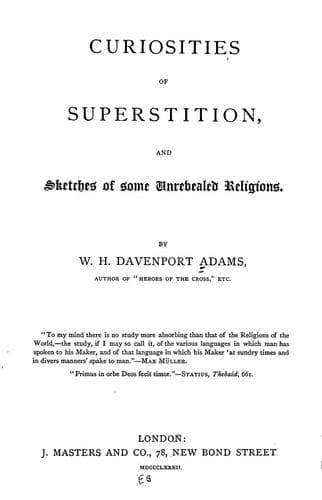
Curiosities of Superstition, and Sketches of Some Unrevealed ReligionsAdams, W. H. Davenport (William Henry Davenport)
Religion
Curiosities of Superstition, and Sketches of Some Unrevealed Religions
Adams, W. H. Davenport (William Henry Davenport)
Folklore; Religions; Superstition
The earth having been duly prepared for the reception of living creatures,
it was peopled by the will-begotten sons of Brahma, the Prajapatis or
patriarchs. But it was necessary to provide these “grey forefathers” of
the early world with wives. For this purpose, the Manu Swayambhuva and his
wife Satarupa, were invented; and their daughters supplied the patriarchs
with female partners. Numerous legends were built up on this basis, and
the whole story assumed an allegorical form. Swayhambhuva, the son of the
self-born or uncreated, and his wife Satarupa, the hundred-formed or
multiform, are themselves allegories; and their female descendants, who
became the wives of the Rishis, are Faith, Devotion, Content,
Intelligence, Tradition, and the like; whilst among their posterity are
found the different phases of the moon and the sacrificial fires. There
are other legends in explanation of the peopling of the earth. All seem to
indicate that the Prajapatis and Rishis were “real personages, the authors
of the Hindu system of social, moral, and religious obligations, and the
first observers of the heavens, and teachers of astronomical science.”
The genealogy is traced of the royal personages of this first race or
dynasty, and is continued into the second book; after which comes a detail
of the geographical system of the Puranas, with Mount Meru, the seven
circular continents, and their surrounding oceans, to the limits of the
world. This (except so far as India or Bharata is concerned) is purely
mythological. In the early portion of the third book, the arrangement of
the Vedas and other sacred writings of the Hindus is described. Then
follows an account of the principal Hindu institutions, the duties of
castes, the obligations of different stages of life, and the celebration
of funeral rites, in a brief but primitive strain, and in harmony with the
laws of Manu. “It is a distinguishing feature of the Vishnu Purana, and it
is characteristic of its being the work of an earlier period than most of
the Puranas, that it enjoins no sectarial or other acts of supererogation;
no Vratas, occasional self-imposed observances; no holy days, no birthdays
of Krishna, no nights dedicated to Lakshmi; no sacrifices or modes of
worship other than those conformable to the ritual of the Vedas. It
contains no Máhálinyas or golden legends, even of the temples in which
Vishnu is adored.”
The fourth book contains a tolerably full list of royal dynasties and
individuals, with a dull chronicle of events, the authenticity of which
cannot always be accepted. In the fifth book we have the life of Krishna,
one of the avatars or manifestations of Vishnu; and in the last an account
of the dissolution of the world, “in both its major and minor cataclysms,”
which, “in the particulars of the end of all things by fire and water, as
well as in the principle of their perpetual renovation, presents a
faithful exhibition of opinions that were general in the ancient world.”
Public-domain text, read in full here on John Shaqi.
Reviews
Reviews
No reviews yet
Be the first to share your thoughts on this work.
Elsewhere in the archive
Join the Discussion
Join the discussion
Sign in to leave a comment or review.
Sign InorCreate an account