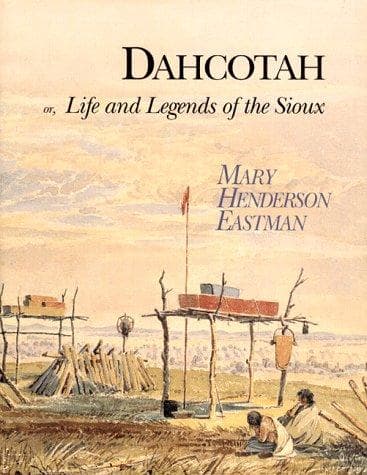
Dahcotah: Life and Legends of the Sioux Around Fort SnellingEastman, Mary H. (Mary Henderson)
History
Dahcotah: Life and Legends of the Sioux Around Fort Snelling
Eastman, Mary H. (Mary Henderson)
Dakota Indians -- Folklore; Dakota Indians -- History; Dakota Indians -- Social life and customs
Their dances and feasts are not amusements. They all have an object and
meaning, and are celebrated year after year, under a belief that neglect
will be punished by the Great Spirit by means of disease, want, or the
attacks of enemies. All their fear of punishment is confined to what
they may suffer in this world. They have no fear of the anger of their
deities being continued after death. Revolting as the ceremony of
dancing round a scalp seems to us, an Indian believes it to be a sacred
duty to celebrate it. The dancing part is performed by the old and young
squaws. The medicine men sing, beat the drum, rattle the gourd, and use
such other instruments as they contrive. Anything is considered a
musical instrument that will assist in creating discordant sound. One of
these is a bone with notches on it, one end of which rests on a tin pan,
the other being held in the left hand, while, with a piece of bone in
the right, which a medicine man draws over the notches, sounds as
discordant and grating as possible are created.
The squaws dance around the scalps in concentric circles, in groups of
from four to twelve together, pressing their shoulders against each
other, and at every stroke of the drum raising themselves to their
utmost height, hopping and sliding a short distance to the left,
singing all the time with the medicine men. They keep time perfectly. In
the centre, the scalps are attached to a pole stuck in the ground, or
else carried on the shoulders of some of the squaws. The scalp is
stretched on a hoop, and the pole to which it is attached is several
feet long. It is also covered with vermilion or red earth, and
ornamented with feathers, ribbons, beads, and other trinkets, and
usually a pair of scissors or a comb. After dancing for a few minutes,
the squaws stop to rest. During this interval one of the squaws, who has
had a son, husband, or brother killed by a warrior of the tribe from
which the scalp she holds was taken, will relate the particulars of his
death, and wind up by saying, "Whose scalp have I now on my shoulders?"
At this moment there is a general shout, and the dance again commences.
This ceremony continues sometimes, at intervals, for months; usually
during the warm weather. After the dance is done, the scalp is buried or
put up on the scaffold with some of the deceased of the tribe who took
the scalp. So much for the scalp dance--a high religious ceremony, not,
as some suppose, a mere amusement.
Public-domain text, read in full here on John Shaqi.
Reviews
Reviews
No reviews yet
Be the first to share your thoughts on this work.
Join the Discussion
Join the discussion
Sign in to leave a comment or review.
Sign InorCreate an account