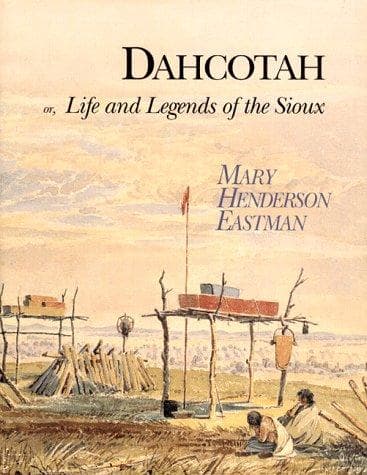
Dahcotah: Life and Legends of the Sioux Around Fort SnellingEastman, Mary H. (Mary Henderson)
History
Dahcotah: Life and Legends of the Sioux Around Fort Snelling
Eastman, Mary H. (Mary Henderson)
Dakota Indians -- Folklore; Dakota Indians -- History; Dakota Indians -- Social life and customs
Sedgwick are, perhaps, alone among our writers in their attempts to do
the Indian justice, while making him the poetical machine in fiction.
Missionaries, however, as well as others who have lived among the
aborigines for purely benevolent purposes, have discovered in them
capabilities and docility which may put to the blush many of the whites
who despise and hate them. Not only in individual cases, but in more
extended instances, the Indian has been found susceptible of religious
and moral instruction; his heart has warmed to kindness, like any other
man's; he has been able to perceive the benefits of regular industry;
his head has proved as clear in the apprehension of the distinction
between right and wrong as that of the more highly cultivated moralist;
and he receives the fundamental truths of the gospel with an avidity,
and applies them--at least to the lives and characters of his
neighbors--with a keenness, which show him to be not far behind the rest
of mankind in sensibility and acuteness. Without referring to the
testimony of the elder missionaries, which is abundant, I remember a
most touching account, by Rev. George Duffield, jr., of piety in an
Indian wigwam, which I would gladly transfer to these pages did their
limits admit. It could be proved by overwhelming testimony, that the
Indian is as susceptible of good as his white brother. But it is not
necessary in this place to urge his claim to our attention on the ground
of his moral and religious capabilities. Setting them aside, he has many
qualifications for the heroic character as Ajax, or even Achilles. He is
as brave, daring, and ruthless; as passionate, as revengeful, as
superstitious, as haughty. He will obey his medicine man, though with
fury in his heart and injurious words upon his lips; he will fight to
the death for a wife, whom he will afterwards treat with the most
sovereign neglect. He understands and accepts the laws of spoil, and
carries them out with the most chivalric precision; his torture of
prisoners does not exceed those which formed part of the "triumphs" of
old; his plan of scalping is far neater and more expeditious than that
of dragging a dead enemy thrice round the camp by the heels. He loves
splendor, and gets all he can of it; and there is little essential
difference, in this regard, between gold and red paint, between diamonds
and wampum. He has great ancestral pride--a feeling much in esteem for
its ennobling powers; and the _totem_ has all the meaning and use of any
other armorial bearing. In the endurance of fatigue, hunger, thirst, and
exposure, the forest hero has no superior; in military affairs he fully
adopts the orthodox maxim that all stratagems are lawful in war. In
short, nothing is wanting but a Homer to build our Iliad material into
"lofty rhyme," or a Scott to weave it into border romance; and as we are
encouraged to look for Scotts and Homers at some future day, it is
Public-domain text, read in full here on John Shaqi.
Reviews
Reviews
No reviews yet
Be the first to share your thoughts on this work.
Join the Discussion
Join the discussion
Sign in to leave a comment or review.
Sign InorCreate an account