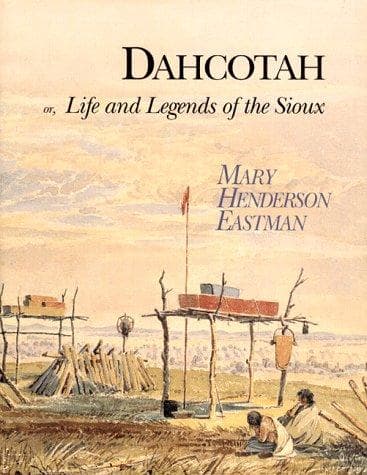
Dahcotah: Life and Legends of the Sioux Around Fort SnellingEastman, Mary H. (Mary Henderson)
History
Dahcotah: Life and Legends of the Sioux Around Fort Snelling
Eastman, Mary H. (Mary Henderson)
Dakota Indians -- Folklore; Dakota Indians -- History; Dakota Indians -- Social life and customs
The war-dance is always celebrated before a war party goes out to find
an enemy, and there is in every village a war chief, who conducts the
party. The war dance is performed inside of a wigwam, and not out of
door, as is usually represented.
The "Owl" felt himself qualified in every respect to conduct the present
party. He was a great warrior, and a juggler besides; and he had a
reputation acquired from an act performed when he was a very young man,
which showed as much cunning as bravery; for one of these qualities is
as necessary to a Dahcotah war chief as the other.
He was one of a party of Dahcotahs who went to war against the
Chippeways, but without success. On their way back "the Owl" got
separated from the rest of the party, and he climbed a tree to see if he
could discover his comrades. While in the tree a war party of the
Chippeways came in sight and stopped quite near the tree to make
their camp.
The Owl was in a sad predicament; he knew not what to do to effect his
escape. As he knew he had not the power to contend with his enemies, he
determined to have recourse to stratagem. When it was quite dark he
commenced hooting like an owl, having previously transformed himself
into one. The Chippeways looked up towards the tree and asked the owl
what he was doing there. The owl replied that he had come to see a large
war party of Dahcotahs who would soon pass by. The Chippeways took the
hint, and took to their heels too, and ran home. The Owl then resumed
his form, got down from the tree and returned home.
This wonderful incident, which he related of himself, gave him a great
reputation and a name besides; for until now he had been called Chaskè,
a name always given to the oldest son; but the Indians after this gave
him the name of the Owl.
It being decided that the war party should leave as soon as their
preparations could be made, the war chief sent for those who were to
dance. The dance was performed every third or, fourth night until the
party left. For each dance the war chief had a hew set of performers;
only so many were asked at a time as could conveniently dance inside the
wigwam. While some were dancing, others were preparing for the
expedition, getting extra mocassins made, drying meat, or parching corn.
When all was ready, the party set out, with every confidence in their
war chief. He was to direct them where to find the enemy, and at the
same time to protect them from being killed themselves.
For a few days they hunted as they went along, and they would build
large fires at night, and tell long stories, to make the time pass
pleasantly.
Public-domain text, read in full here on John Shaqi.
Reviews
Reviews
No reviews yet
Be the first to share your thoughts on this work.
Elsewhere in the archive
Join the Discussion
Join the discussion
Sign in to leave a comment or review.
Sign InorCreate an account