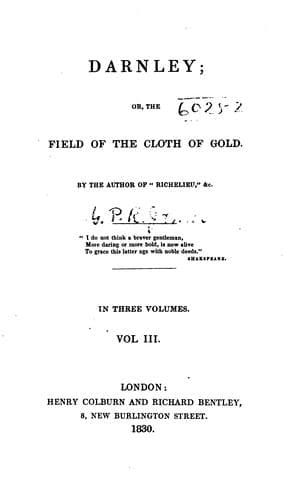
Darnley; or, The Field of the Cloth of Gold — John Shaqi
Darnley; or, The Field of the Cloth of GoldJames, G. P. R. (George Payne Rainsford)
History
Darnley; or, The Field of the Cloth of Gold
James, G. P. R. (George Payne Rainsford)
Great Britain -- History -- Henry VIII, 1509-1547 -- Fiction; Henry VIII, King of England, 1491-1547 -- Fiction
He rose and grasped Sir Osborne's hand, and fixed his dark eye upon
his face. "'Tis hard to part with existence--the warm ties of life,
the soft smiling realities of a world we know--and to begin it all
again in forms we cannot guess. Yet, if my will could alter the law of
fate, I would not delay your happiness an hour; though I know, I feel,
that this thrilling blood must then chill, that this quick heart must
stop, that the golden light and the glorious world must fade away; and
that my soul must be parted from its fond companion of earth for ever
and for ever. Yet it shall be so. It is said. Reply not! Speak not!
Follow me! Hush! hush!" And proceeding to the door of the cottage, he
mounted his palfrey, which stood ready, and motioned Sir Osborne to do
the same. The young knight did so in silence, and rode along with him
to the garden-gate, followed by the old cottagers. There Richard
Heartley, as if accustomed so to do, held out his hand; Sir Cesar
counted into it nine nobles of gold, and proceeded on the road in
silence.
CHAPTER III.
Illusive dreams in mystic forms expressed.--Blackmore.
That which is out of the common course of nature, and for which we can
see neither cause nor object, requires of course a much greater body
of evidence to render it historically credible than is necessary to
authenticate any event within the ordinary operation of visible
agents. Were it not so, the many extraordinary tales respecting the
astrologers, and even the magicians of the middle ages, would now rest
as recorded truth, instead of idle fiction, being supported by much
more witness than we have to prove many received facts of greater
importance.
Till the last century, the existence of what is called the second
sight, amongst the Scots, was not doubted: even in the present day it
is not disproved; and we can hardly wonder at our ancestors having
given credence to the more ancient, more probable, more reasonable
superstition of the fates of men being influenced by the stars, or at
their believing that the learned and wise could see into futurity,
when many in this more enlightened age imagine that some of the rude
and illiterate possess the same faculty.
Public-domain text, read in full here on John Shaqi.
Reviews
Reviews
No reviews yet
Be the first to share your thoughts on this work.
Join the Discussion
Join the discussion
Sign in to leave a comment or review.
Sign InorCreate an account