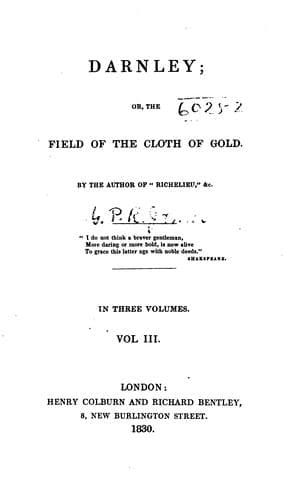
Darnley; or, The Field of the Cloth of Gold — John Shaqi
Darnley; or, The Field of the Cloth of GoldJames, G. P. R. (George Payne Rainsford)
History
Darnley; or, The Field of the Cloth of Gold
James, G. P. R. (George Payne Rainsford)
Great Britain -- History -- Henry VIII, 1509-1547 -- Fiction; Henry VIII, King of England, 1491-1547 -- Fiction
It is not, however, my object here to defend long-gone superstitions,
or to show that the predictions of the astrologers were ever really
verified, except by those extraordinary coincidences for which we
cannot account, and some of which every man must have observed in the
course of his own life. That they were so verified on several
occasions is nevertheless beyond doubt; for it is _not_ the case that,
in the most striking instances of this kind, as many writers have
asserted, the prediction, if it may be so called, was fabricated after
its fulfilment. On the contrary, any one who chooses to investigate
may convince himself that the prophecy was, in many instances,
enounced, and is still to be found recorded by contemporary writers,
before its accomplishment took place. As examples might be cited the
prognostication made by an astrologer to Henry the Second of France,
that he should be slain in single combat; a thing so unlikely that it
became the jest of his whole court, but which was afterwards
singularly verified, by his being accidentally killed at a tournament
by Montgomery, captain of the Scottish guards. Also the prediction by
which the famous, or rather infamous, Catherine de Medicis was warned
that St. Germains should be the place of her death. The queen, fully
convinced of its truth, never from that moment set foot in town or
palace which bore the fatal name; but in her last moments, her
confessor being absent, a priest was called to her assistance, by mere
accident, whose name was St. Germains, and actually held her in his
arms during the dying struggle.
These two instances took place about fifty years after the period to
which this history refers, and may serve to show how strongly rooted
in the minds of the higher classes was this sort of superstition, when
even the revival of letters, and the diffusion of mental light, for
very long did not seem at all to affect them. The habits and manners
of the astrologers, however, underwent great changes; and it is,
perhaps, at the particular epoch of which we are now writing, namely,
the reigns of Henry the Eighth of England and Francis the First of
France, that this singular race of beings was in its highest
prosperity.
Before that time, they had in general affected strange and retired
habits, and, whether as magicians or merely astrologers, were both
feared and avoided. Some exceptions, however, must be made to this, as
instances are on record where, even in years long before, such studies
were pursued by persons of the highest class, and won them both love
and admiration; the most brilliant example of which was in the person
of Tiphaine Raguenel, wife of the famous Constable du Guesclin, whose
counsels so much guided her husband through his splendid career.
Public-domain text, read in full here on John Shaqi.
Reviews
Reviews
No reviews yet
Be the first to share your thoughts on this work.
Join the Discussion
Join the discussion
Sign in to leave a comment or review.
Sign InorCreate an account